
Three 2023 papers, three different evidence questions
This selection asks how to make spectral and geospatial learning claims easier to interpret. HySpecNet-11k makes the unit of a data split explicit; the HSI adaptation of PAWS makes label use during representation learning explicit; ben-ge makes auxiliary geographic and environmental information explicit. Together they offer a practical way to read beyond an architecture diagram. [1][2][3][4]
The scope is three papers from the published IGARSS 2023 edition. Two directly concern hyperspectral imagery; ben-ge concerns multimodal Earth observation and is included for its data-fusion and evaluation lessons. The accessible full-text author manuscripts were inspected for methods, experiments and conclusions. Publication identity was cross-checked against official program, project or institutional records. This is a selected reading guide checked on 2 October 2026, not an account of attendance or a survey of IGARSS 2026. [1][5][6][8]
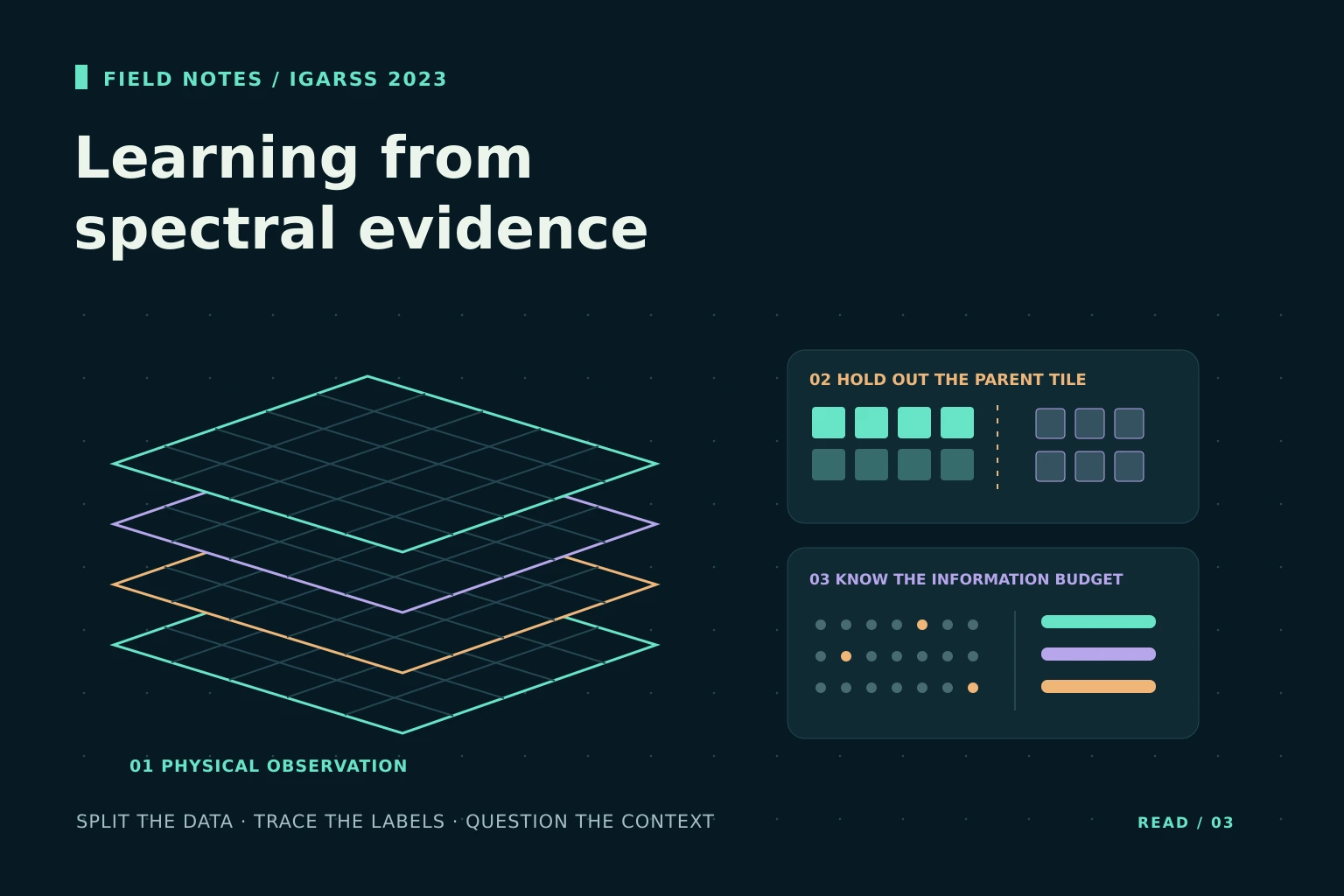
The organizing question is simple: what information can the model use, and what information is genuinely new at evaluation? Read each paper with a small ledger containing observations, labels, context, split unit and output. When these entries change, the interpretation of a reported result may change too. That is worth understanding before choosing a more elaborate network.
HySpecNet-11k: non-overlapping patches still need a split policy
HySpecNet-11k provides 11,483 non-overlapping EnMAP patches. Its two evaluation splits are the important reading point: the easy split can place patches from the same tile in different subsets, while the hard split keeps a tile together. The paper’s initial compression benchmark uses the easy split. Read §2 and the first part of §4 together before describing a result as transfer to an unseen tile. [2]
The input contract also needs care. The source data have 224 bands, while the documented preprocessed learning arrays retain 202 after removing water-absorption bands. The project FAQ additionally explains clipping, rescaling and float32 conversion. A generic statement that the experiment uses “the HySpecNet bands” would hide a real preprocessing choice. [2][5]
My read-first question is whether the application needs new patches from familiar acquisitions or genuinely separate acquisition tiles. Neither split name is a substitute for that deployment question. For a follow-on study, report the split identifier and parent-tile mapping, then inspect error across wavelengths as well as any global reconstruction summary. That would be a new evaluation, not a result claimed here.
| Paper | Data and target | Method / protocol | What to read first / artifact |
|---|---|---|---|
| HySpecNet-11k | EnMAP; spectral reconstruction | Convolutional compression baselines; easy versus hard split | §2 split unit; official tools and preprocessing FAQ [2][5] |
| HSI PAWS adaptation | Houston 2013 and Pavia; pixel labels | Support-guided view assignments; separate downstream readouts | §2 label access, §3 patch sampling; PDF available, code not verified [3][6] |
| ben-ge | BigEarthNet-MM plus context; WorldCover-derived targets | Late fusion and supervised modality/size comparisons | §3 inputs versus targets; data/splits documented, code/weights forthcoming in README [4][7] |
HSI PAWS: label access belongs in the pretraining description
Pande and colleagues adapt Predicting View Assignments With Support Samples to HSI. Two augmented, overlapping views of an unlabeled patch are compared with labeled support representations using a soft nearest-neighbour rule. Their predicted label distributions guide representation learning. The downstream evaluations distinguish a frozen linear head, full fine-tuning and a non-parametric classifier. Read §2 before calling the pretraining purely unsupervised. [3]
The experiments use Houston 2013 and Pavia University, with 100 support samples per class and spatially overlapping anchor/positive patches. The paper lists spectral, spatial and joint augmentations, including channel operations. These are components of the reported setup, not a universal physical prescription for hyperspectral augmentation. [3]
My first audit would draw the allowed data pools before and after support labels enter the pipeline. Ask whether unlabeled examples include the eventual evaluation scene, and whether train and test patch footprints overlap. These are questions to resolve for a reproduction, not allegations that the paper violates a protocol. For transfer to a different sensor or material task, reconsider every augmentation against the intended invariant.
Sources: [3]
ben-ge: context changes the learning problem
ben-ge extends BigEarthNet-MM with elevation, land-cover products, environmental variables, climate zones and seasonal encoding. Its paper studies supervised patch classification and pixel-wise segmentation with ESA WorldCover-derived targets. Multiple inputs are combined through separate backbones and late fusion. Read the target definition before treating every provided modality as an eligible input. [4]
The study varies band subsets, dataset size and modality combinations, uses fixed 80/10/10 splits and reports repeated runs. The authors explicitly caution that class imbalance compromises accuracy as a standalone interpretation. Their discussion also limits the conclusions to the examined downstream tasks and modality combinations. [4]
For an HSI researcher, the useful question is what a gain from context means. Elevation or season may be useful ancillary evidence without demonstrating improved spectral discrimination. A sensible follow-on comparison would separate spectral-only, context-only and fused inputs on the same held-out groups. Keep the source of the target and its derivatives out of the predictor set unless the task explicitly allows them.
Sources: [4]
Reading order: define the sample before judging the representation
Start with HySpecNet’s split description and identify the parent unit behind each array. Move to PAWS and mark the first point where a human label influences training. Finish with ben-ge and list each auxiliary observation available at prediction time. The resulting three-column note is more useful than a single list of best accuracies because it describes the information boundary of each experiment.
Then translate that boundary into the intended use case. A new pixel in a known scene, a new field, a different flight line and a different satellite are distinct generalization questions. They may share a tensor shape but differ in acquisition conditions and context. Choose the grouping rule before touching model selection. If the task is within-scene mapping, describe it that way rather than suggesting unseen-region transfer.
A compact comparison should make four budgets visible: labeled support, unlabeled observations, auxiliary context and tuning effort. A method can improve because one of those budgets expands. That may still be a useful engineering result; it just answers a different question from improved representation quality under equal information. Keep both interpretations available to the reader.
Artifacts: availability is part of the evidence
HySpecNet’s official project links its data, tools and model resources. The FAQ says the preprocessed DATA.npy files are generated with its conversion notebook, and the dataset follows the EnMAP data agreement. A linked archive therefore does not mean a ready-to-run tensor directory with unrestricted redistribution rights. The project page was inspected here; no dataset archive or weights were downloaded. [5]
For the HSI PAWS paper, the DLR record provides the author PDF and the published DOI. A verified implementation repository was not established in this reading pass, so the paper is a methods reference rather than a claimed turnkey reproduction. An unavailable artifact is a reason to budget reconstruction work, not to invent a repository or silently borrow another implementation. [6]
The ben-ge repository provides modular data links and split information, but its inspected README still says the usage code and pretrained models will be made available soon. The data documentation is useful; that wording does not establish that the promised training package is released. Record this gap before scheduling a reproduction. [7]
Three useful follow-on checks, without a new benchmark claim
First, create a provenance manifest for a chosen dataset. Include parent scene or tile, timestamp, channel order, band mask, normalization rule and split assignment. Validate identifiers before loading a model. For a patch task, add the footprint so an overlap check can be performed on spatial support rather than centre coordinates alone.
Second, write an information-budget table for the training stages. Distinguish an unlabeled input pool from a labeled support pool, and document which observations the final test may share with pretraining. If a representation is learned from the test region without test labels, make that access visible. A clear transductive setting is easier to assess than a vague claim of label-free transfer.
Third, decide what context should be available operationally. A climate class, a date or a map layer can be a legitimate predictor, but its source and version matter. Check temporal compatibility, missing values and target derivation. If a new region has no equivalent context layer, include a missing-context condition in the study plan.
These are proposed checks, not experiments run for this article. Their purpose is to turn the three papers into a sharper question for a future study. The stopping point is a small, inspectable protocol with a known artifact gap and a result that would count against the hypothesis. That is enough to make the next read or reproduction decision worthwhile.
Download this reading guide and original cover (ZIP)
Frequently asked questions
Why is the guide about IGARSS 2023?
The selected 2023 papers form a coherent reading route about split design, label access and contextual inputs. The date is explicit; this is not a latest-proceedings roundup.
Are all three papers hyperspectral methods?
No. HySpecNet-11k and the PAWS adaptation directly concern HSI. ben-ge is a multispectral/radar and ancillary-data resource included for its evaluation and fusion lessons.
Does non-overlap prove unseen-scene transfer?
Non-overlapping patches can still share a parent acquisition. HySpecNet explicitly distinguishes patchwise and tilewise splits; the intended transfer question determines which is relevant.
Does the PAWS setup use labels during pretraining?
Yes. Labeled support samples guide assignments for unlabeled views, so the described representation learning is semi-supervised.
Do 224 and 202 HySpecNet bands conflict?
They refer to different representations: the source spectral cube and the documented preprocessed array after water-absorption bands are removed. State which one is supplied to the model.
Are all reproductions ready to run?
No. The selected PDFs were read, but no training was run. HSI PAWS code was not verified, and the inspected ben-ge README still lists usage code and pretrained models as forthcoming.
References and further reading
- IEEE IGARSS 2023: accepted papers and edition
- Fuchs and Demir. HySpecNet-11k. IGARSS 2023; author manuscript arXiv:2306.00385v2, 2 June 2023, §§2–4.
- Pande et al. Semi-Supervised Learning for Hyperspectral Images by Non-Parametrically Predicting View Assignment. IGARSS 2023; author manuscript v1, §§2–3.
- Mommert et al. Ben-ge: Extending BigEarthNet with Geographical and Environmental Data. IGARSS 2023; author manuscript arXiv:2307.01741v1, §§2–4.
- HySpecNet-11k official project: splits, preprocessing and data terms
- DLR publication record: HSI non-parametric view-assignment paper and published DOI
- ben-ge official repository: modalities, split files and artifact status
- IEEE IGARSS 2023 official program record: ben-ge
Reader feedback
Reads since 1 October 2026: at least 15 seconds with the article visible, counted once per browser per day. Reactions are anonymous and can be changed.
Loading reader feedback…
Discuss this article
Ask a technical question, challenge an assumption or share evidence from your own work.