
Distinguish three questions
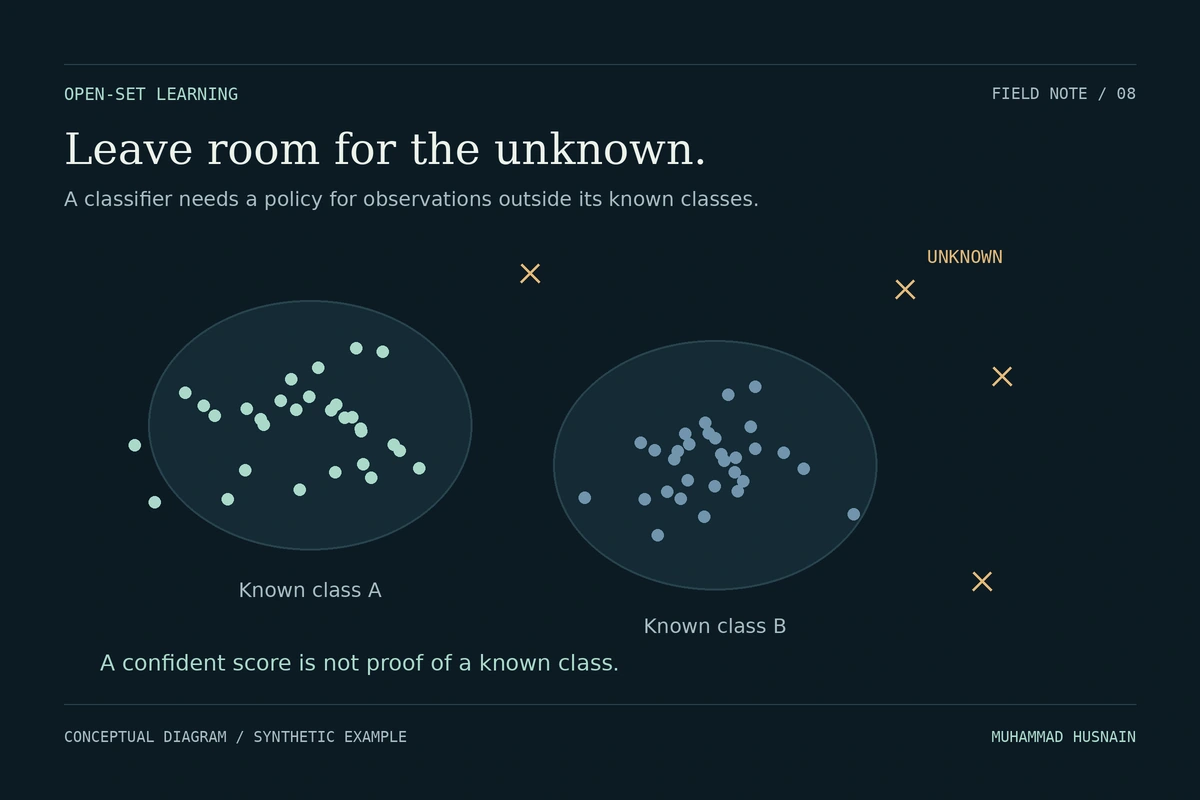
A land-cover classifier trained on grass, trees and asphalt may encounter roofing, a novel crop or an unlabelled artificial target. A closed-set classifier still returns one of its known classes. The important question becomes whether the system should accept that label, flag an unfamiliar observation, or request a new annotation.
Three problems need separate definitions. Open-set recognition includes test classes absent from labelled training. Distribution-shift detection concerns observations that differ from the training distribution, which can include familiar classes under a new sensor. Selective prediction allows the model to abstain on difficult cases, including ordinary known-class mistakes. Success on one does not establish success on the others.
Start with a transparent reject score
Hendrycks and Gimpel introduced maximum softmax probability as a simple baseline for identifying misclassified and out-of-distribution examples. [1] For an HSI classifier, a transparent starting rule accepts the predicted class when its maximum probability exceeds a fixed threshold and abstains otherwise.
This baseline is easy to audit, but a softmax vector distributes probability across the available classes. It does not measure whether those classes exhaust the possible materials. A model can confidently assign an unfamiliar spectrum to the nearest known class. Low confidence can also arise from a mixed boundary between familiar materials.
Keep the score and its direction explicit. A confidence score may accept high values; an anomaly score may reject high values. Save continuous scores as well as thresholded labels so that the operating trade-off can be inspected without rerunning inference.
Separate unknown classes from sensor shift
Design distinct test conditions for known classes under familiar acquisition, held-out classes under similar acquisition, and known classes under changed acquisition. Add the combination of new classes and acquisition shift when the dataset supports it. This grid makes it possible to see whether the detector responds to semantic novelty or simply to a different sensor.
Build the class partition before tuning. Reserve development unknowns, if available, for selecting methods and thresholds; final unknown classes remain hidden. If only known-class development data are used, state that constraint. A threshold calibrated on one set of unknown materials cannot guarantee rejection of every future material.
In a single-scene experiment, class holdout can change the geography and background composition at the same time. Report those changes. An unknown roof class confined to one part of the map may be easier to detect because of location or illumination rather than material identity.
Compare specialised models with baselines
OpenMax adapts a deep network for open-set recognition by using activation-space information to model an unknown-class possibility. [2] SelectiveNet instead learns a prediction function and rejection mechanism jointly, optimising performance over the accepted portion of the input domain. [3] Their objectives differ, so they should not be treated as interchangeable labels for an uncertainty output.
For an HSI study, compare the specialised approach against maximum softmax probability and a simple distance-based rule on the same learned features, where appropriate. Match the encoder, pretraining data and accessible labels. Separate an improvement in the representation from an improvement in the rejection mechanism.
A distance rule also has assumptions. Spectral scaling, normalisation, dimensionality reduction and class covariance can change distances substantially. Fit these components only on the allowed development information and document them as part of the detector, not as incidental preprocessing.
Choose thresholds without final-test labels
Define the operational requirement before selecting a threshold. It might limit known-class rejection on a development set, or minimise a stated cost combining wrong accepted labels and review workload. Use development data to choose the threshold, then freeze it for final evaluation.
Guo and colleagues study probability calibration and show that temperature scaling can improve calibration on their evaluated classification datasets. [4] Calibration addresses whether confidence aligns with correctness under the evaluated conditions. It does not make a closed-set model universally aware of unknown classes or remove the need for separate shift tests.
If a fitted calibration step uses labelled samples, include them in the supervision budget. Record their classes, scenes and acquisition conditions. Report how much final coverage changes under shift at the frozen threshold; forcing the same final coverage by tuning on test scores answers a different, retrospective question.
Work through risk and coverage
Consider a constructed test set of 1,000 known-class pixels and 200 unknown-class pixels. At one fixed threshold, suppose the system accepts 900 known pixels, of which 45 receive a wrong known label, and accepts 30 unknown pixels as known. These counts are illustrative arithmetic, not a benchmark.
Known-class coverage is 900/1,000 = 90%. The classification error among accepted known pixels is 45/900 = 5%. Unknown false acceptance is 30/200 = 15%. If every accepted unknown is counted as an error, there are 75 errors among 930 accepted pixels, giving an overall accepted error rate of about 8.1%. The overall coverage is 930/1,200 = 77.5%.
These quantities answer different questions. Reporting only the 5% known-class selective error hides the unknown failures. Reporting only 77.5% overall coverage hides whether rejection disproportionately affects a rare known class. Always state the denominator and whether unknowns are included.
Report ranking and the operating point
A threshold sweep describes how a score ranks observations. An operating-point result describes what happens when a fixed rule is deployed. Report both when the application needs a decision. State which population is positive for detection metrics, because reversing known and unknown changes precision-recall interpretation.
Include per-class acceptance and accepted error for known classes, plus false acceptance for each unknown group. A detector can reject almost every rare known-class pixel while retaining excellent accepted accuracy on common classes. That is a coverage failure for the rare class, even if the headline risk improves.
When comparing selective methods, use risk-coverage curves over a common evaluation population and report the predefined deployment threshold separately. At zero accepted predictions, accepted error is undefined, not zero. Near-zero coverage also makes empirical risk unstable, so retain the accepted counts.
| Quantity | Calculation | Value |
|---|---|---|
| Known coverage | Accepted known / all known | 900 / 1,000 = 90% |
| Known selective error | Wrong accepted known / accepted known | 45 / 900 = 5% |
| Unknown false acceptance | Accepted unknown / all unknown | 30 / 200 = 15% |
| Overall coverage | All accepted / all evaluated | 930 / 1,200 = 77.5% |
| Overall accepted error | All accepted errors / all accepted | 75 / 930 ≈ 8.1% |
Audit mixed pixels and small objects
A mixed spectrum of known materials is not automatically a new semantic class. Decide how the reference treats mixtures before scoring rejection. If a hard reference labels a boundary as grass, abstaining there may count as rejection of a known class even though the underlying measurement contains asphalt as well.
Keep semantic unknowns, invalid measurements and ambiguous references as distinct audit categories. Saturation, missing bands and severe registration errors may deserve a quality-rejection rule rather than a new material class. Report the order of quality checks and semantic rejection so that excluded data remain visible.
For tiny objects, inspect whether the detector rejects the very pixels the application aims to recover. Report object-size subsets and boundary subsets when reliable references exist. A conservative rejection mechanism can make a map cleaner while removing useful information; a cleaner visualisation alone is not evidence of a better decision system.
Define what happens after rejection
An abstention needs a downstream action: human review, another measurement, an explicit unknown label, or withholding a decision. Estimate the resulting workload using the deployment prevalence of difficult and unknown cases, rather than assuming the balanced benchmark mixture will recur.
Keep rejected observations available for audit, with score, reason, model version and location. If they are later labelled and used for retraining, that is a new learning round requiring new evaluation separation. The useful outcome is a measured trade-off between retained decisions, accepted mistakes and review cost. Continue with domain shift and uncertainty for the acquisition changes that can move this trade-off.
Frequently asked questions
Is a low softmax score proof of an unknown material?
No. It can reflect a difficult known class, noise, a mixed pixel or other shift. Conversely, an unknown material can receive high confidence.
Can rejection guarantee that accepted predictions are correct?
A threshold alone provides no universal guarantee. Any statistical guarantee needs its stated assumptions, calibration procedure and scope; empirical accepted error should still be reported.
Should unknown pixels be removed before reporting accuracy?
Report known-class classification and unknown rejection separately, with explicit denominators. Removing unknowns without reporting their false-acceptance rate conceals a central part of the task.
References and further reading
- Hendrycks and Gimpel: A Baseline for Detecting Misclassified and Out-of-Distribution Examples in Neural Networks
- Bendale and Boult: Towards Open Set Deep Networks
- Geifman and El-Yaniv: SelectiveNet: A Deep Neural Network with an Integrated Reject Option
- Guo et al.: On Calibration of Modern Neural Networks
Reader feedback
Reads since 1 October 2026: at least 15 seconds with the article visible, counted once per browser per day. Reactions are anonymous and can be changed.
Loading reader feedback…
Discuss this article
Ask a technical question, challenge an assumption or share evidence from your own work.