
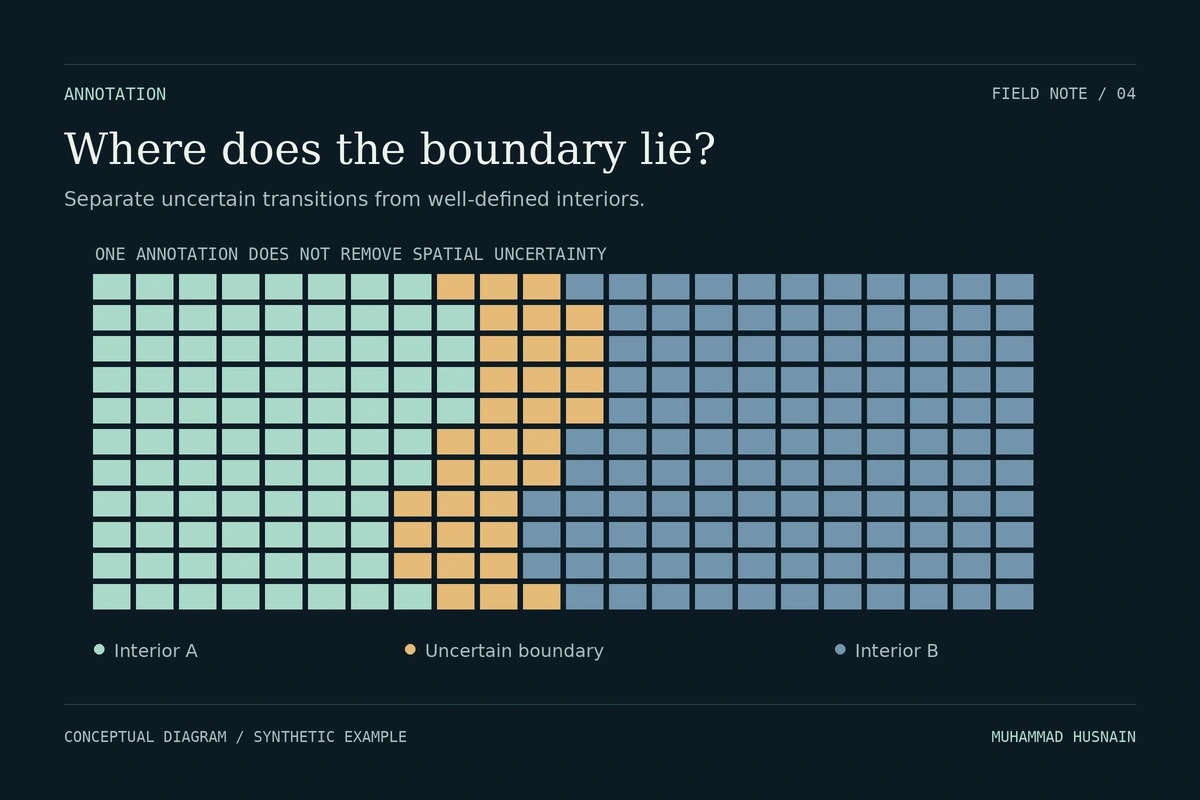
Three different problems can look like the same error
A predicted boundary that disagrees with a reference map is not automatically evidence that the classifier ignored spatial detail. The label may be wrong, the imagery and annotation may be misregistered, or the pixel may contain a genuine material mixture that cannot be represented faithfully by one class. These explanations require different responses.
An annotation mistake assigns a class contrary to the available reference evidence. Registration uncertainty concerns where that evidence lies relative to the measurement grid. A mixed pixel can be correctly measured yet have no unambiguous single-material label. Treating all three as random class flips simplifies the mathematics while changing the scientific problem.
This guide develops an evaluation audit using existing imagery and annotations. It does not assume that model confidence reveals the true label. Its examples are constructed geometry, not measurements. For the physical distinction between mixture and class, see mixed pixels: when classification needs unmixing.
Start with reference provenance and the decision rule
For each reference source, record acquisition date, spatial resolution, georeferencing, annotation procedure and class definitions. A high-resolution RGB outline and a coarse hyperspectral measurement may refer to different times, surface views or spatial supports. A visually sharp polygon is not a guarantee of equally precise alignment with every spectral pixel.
State how polygons become pixel labels. A centre-inside rule, largest-overlap rule and minimum-abundance rule can assign different classes along the same boundary. Keep the chosen rasterisation and tie rule in the evaluation configuration. If a class is assigned from the dominant material, that definition should remain distinct from a requirement that the pixel be pure.
Olofsson and colleagues recommend a response design with reference information adequate in space and time, analysis consistent with that design, and attention to potential reference errors. Applying that principle here means documenting what the annotation actually establishes before counting model disagreements as classification failures. [1]
Sources: [1]
Quantify how alignment changes a small reference
Imagine a two-pixel-wide rectangular object that is six pixels long. Translating its reference mask by one pixel perpendicular to the long edge replaces half of its labelled support. An otherwise perfect prediction of the original mask would now overlap the shifted reference in six pixels with a union of eighteen: IoU is one third.
For a ten-pixel-wide object of the same length, the equivalent one-column translation gives an intersection of 54 and a union of 66, an IoU of approximately 0.818. The absolute registration perturbation is the same, but its effect depends strongly on object width. This is why tiny and thin structures deserve separate scrutiny when reference alignment is uncertain.
These calculations do not justify shifting the evaluation labels to maximise a model score. Estimate alignment from independent information, freeze the correction and apply it consistently to every method. A model-specific best shift uses the predictions to redefine the target and can reward spatially inaccurate outputs.
| Mask dimensions | Intersection | Union | IoU |
|---|---|---|---|
| 2 × 6 pixels | 6 | 18 | 0.333 |
| 10 × 6 pixels | 54 | 66 | 0.818 |
Evaluate interiors and boundary bands without erasing the task
Create a boundary diagnostic from the reference map using a declared neighbourhood, distance definition and band width. Report scores inside that band and in the remaining interior, together with the number of evaluated pixels and class support in both. Keep the full-map result visible so the diagnostic cannot be mistaken for a replacement benchmark.
Boundary width should be expressed in pixels and, when meaningful, physical units. A fixed one-pixel band corresponds to different distances at different ground sampling resolutions. A fixed metric-distance band may cover almost all of a tiny object. Show this coverage so readers can tell whether an apparent interior comparison excludes the objects of interest.
Boundary IoU measures segmentation quality through boundary regions and was designed to expose errors that mask overlap can underemphasise. It is a useful complementary metric, but it does not validate the reference boundary itself. Record its published construction and parameters, and distinguish it from a simple accuracy score on a dilated edge mask. [2]
Sources: [2]
If labels are ignored, report what disappears
An uncertainty mask can be justified when reference evidence cannot support a defensible label. It should be derived independently of the competing predictions, applied consistently and accompanied by coverage statistics. Record excluded area by class, object size and spatial context, not only one overall percentage.
Removing a narrow band around every class boundary can eliminate a disproportionate share of small objects. In the extreme, the entire evaluation support of a thin target disappears. A higher score on the remaining interiors then describes an easier and narrower task. It cannot establish better fine-grained performance.
Where appropriate, report both the original benchmark score and an explicitly scoped high-confidence subset analysis. Keep the uncertainty policy fixed before comparing methods. If new evidence corrects labels, version the corrected reference and re-evaluate every baseline on the same version rather than updating only the proposed model’s result.
Northcutt, Athalye and Mueller document errors in widely used test sets and examine their effects on model comparisons. Their study does not estimate an HSI annotation-error rate, but it demonstrates why a reference revision can change the interpretation of a benchmark. Any corrected HSI evaluation should therefore identify the reference version and apply it consistently to all compared methods. [4]
Sources: [4]
Use disagreement to prioritise review, not to declare truth
Confident learning studies label-quality estimation under assumptions including a class-conditional noise process. It offers a principled way to reason about suspected label errors, but the assumptions are part of the method. Boundary mixtures, spatially varying alignment and unrepresented minority materials can violate a simple class-conditional model. [3]
A high-confidence model disagreement is therefore a review candidate. It may indicate a label mistake, an unusual valid example, a domain shift or a model that is confidently wrong. Ranking disagreements for inspection can save annotation effort; automatically replacing them with the model prediction risks converting systematic model bias into the reference.
Use predictions from models that did not train on the inspected labels when the review procedure requires out-of-sample evidence, and retain the underlying image context. Record the original label, suggested change, independent evidence and final decision. Keep unresolved cases unresolved rather than forcing a clean-looking dataset.
Sources: [3]
Make sensitivity analysis a fixed protocol
When reference alignment uncertainty is bounded but cannot be fully resolved, evaluate a small set of justified perturbations shared by all methods. Report the original result and the range or distribution under those perturbations. Do not select an individual best translation for every model or object and report only that favourable result.
For categorical ambiguity, a separate analysis can use adjudicated labels or a documented set of acceptable classes when the benchmark permits it. That changes the scoring rule and must remain distinct from ordinary single-label accuracy. Soft labels require a reference interpretation and an appropriate scoring rule; assigning a convenient probability to an uncertain boundary does not measure abundance.
Use these analyses to test whether the comparative conclusion is stable. If the ordering changes under a plausible one-pixel registration perturbation, the difference may be smaller than the reference precision can resolve. Reporting that limitation is more informative than attaching additional decimal places to the original score.
Release the annotation decisions needed to interpret the result
A useful annotation record includes source identifiers, timestamps, coordinate systems, transformation versions, class definitions, rasterisation rules, ignore masks, review decisions and the final reference hash. Keep the raw reference separate from derived evaluation masks so a later audit can reproduce how each pixel entered the metric.
For each reported subset, publish evaluated pixel counts, reference object counts where available and class coverage. Link representative disagreements to the full evaluation mask rather than showing only selected crops. Pair boundary diagnostics with object-level evaluation when the application depends on small entities surviving as distinct structures.
The goal is a result whose meaning survives scrutiny. A model can be excellent on well-aligned interiors, uncertain on mixed boundaries and weak on tiny objects at the same time. An honest evaluation makes those distinctions visible and avoids asking the reference data to support a precision they never contained.
Frequently asked questions
Should all boundary pixels be removed?
No. That can remove the very fine structures the task is intended to evaluate. Use justified uncertainty masks, disclose coverage and retain the complete benchmark result.
Is a mixed pixel a wrong label?
Not necessarily. It may be a valid measurement represented by an intentionally simplified dominant-class convention. The problem is interpreting that convention as a pure-material truth.
Can a confident classifier correct the test set?
Its disagreements can prioritise independent review, but confidence alone is not sufficient evidence. Version any corrected reference and evaluate all methods consistently.
References and further reading
Reader feedback
Reads since 1 October 2026: at least 15 seconds with the article visible, counted once per browser per day. Reactions are anonymous and can be changed.
Loading reader feedback…
Discuss this article
Ask a technical question, challenge an assumption or share evidence from your own work.