
EarthVision 2024: evaluate the part that can fail
Three workshop papers make a useful diagnostic reading set. One asks whether an image is unusual relative to training data. One asks whether robust features help identify scarce object categories. One asks whether a vision-language model can count and localize rather than merely describe. Their common value is that each makes an apparently simple output depend on a more precise evaluation contract. [2][3][4]
The scope is the EarthVision collection in the CVPR 2024 Workshops proceedings. These are workshop papers, not CVPR main-conference papers. The official CVF PDFs were read for selected methods, datasets, evaluation and limitations, and the reading was checked on 2 October 2026. The selection is neither an attendance report nor a complete workshop survey. It also makes no claim about the capabilities of current 2026 models. [1]
This guide is oriented toward fine-grained remote-sensing evaluation. It is not an HSI model leaderboard: the selected image protocols do not establish narrow-band spectral discrimination. Their transferable contribution is a way to ask where an error arises and what evidence would distinguish an input problem, a representation problem and an output-protocol problem.
Diffusion OOD detection: define what unusual means
Le Bellier and colleagues compare diffusion-based out-of-distribution scorers, including ODEED, which encodes and decodes an image along an estimated probability-flow ODE and measures reconstruction discrepancy. Their SpaceNet 8 setups distinguish pre-event versus post-event, visible flood versus non-flood, and geographic-domain shift. Those definitions create different detection problems, even though they use related imagery. Read §4.2 before comparing scores. [2]
A particularly useful caveat is that flood labels are derived from flooded roads or buildings: a flooded area without either can be treated as non-flooded by the proxy. The authors also discuss a shift in score distributions across geographic domains, meaning that a threshold need not transfer unchanged. These limitations are visible in the method’s evaluation, not merely hypothetical concerns. [2]
My first question is what operational action follows a high score. An acquisition artifact, a new region and a harmful event need different responses. Choose the positive condition before selecting a metric. Then define a threshold on allowed validation data and record both missed events and unnecessary reviews; a ranking statistic alone does not choose that operating point.
Sources: [2]
| Paper | Question / data | Method and protocol | First read / artifact |
|---|---|---|---|
| Diffusion OOD / ODEED | Event or domain difference in SpaceNet 8 | Reconstruction-based scorers; three distinct OOD definitions | §4.2 labels and §5 threshold shift; official PDF, code not verified [2] |
| Robust few-shot features | Scarce object classes in SIMD and DIOR | Proposal stage plus frozen features and trainable prototypes | §3 pipeline, §4.2 proposal limits; PDF/supplement, code not verified [3] |
| VLEO / GPT-4V benchmark | Scene, localization, count and change tasks | Task-specific scoring with refusal/format accounting | Counting evaluation and supplement; project links data/code, no run [4][5][6][7] |
Few-shot detection: a good classifier cannot rescue a missing box
Bou and colleagues use a region-proposal stage plus frozen pretrained features and object/background prototypes. They evaluate visual and vision-language backbones for few-shot detection on SIMD and DIOR after proposal training on DOTA. Their method fine-tunes prototypes while keeping the representation backbone frozen. Read §3 to see exactly which part learns from the scarce examples. [3]
The paper’s limitations identify a proposal bottleneck when novel categories differ strongly from those used to train the proposal network. It also discusses background content inside object boxes. This helps explain why fine-grained discrimination among familiar broad objects and discovery of genuinely new object types should be examined separately. [3]
My first diagnostic would separate proposal recall from classification conditional on a suitable proposal. If a box never appears, changing a class prototype may not address the failure. For an intended low-label evaluation, inspect the actual instances and images in each support split, including co-occurring objects. Treat a nominal shot count as a documented sampling contract rather than an automatic guarantee of equal supervision.
Sources: [3]
VLEO: fluent captions do not settle spatial questions
Zhang and Wang build an application-oriented evaluation across scene understanding, localization, counting and change detection. The 2024 study includes GPT-4V and four named open-model variants. It uses task-specific metrics and separately records refusals or invalid output formats. For counting, the paper distinguishes metrics calculated on answered cases from alternatives that score refusals differently. Read the evaluation rules, not only the example captions. [4]
The reported study finds substantial difficulty with counting and localization relative to its high-level scene tasks. Its supplementary discussion notes the benchmark’s static nature and incomplete coverage of desired capabilities. These are historical findings about the tested systems and protocol; they are not a fresh evaluation of today’s assistants. [4][6]
My first audit would retain every raw response, parse result and refusal alongside the input identifier. A parser failure should not disappear silently from the denominator. Separate correctness on answered examples from coverage, and keep the image preparation, prompt and model version fixed during a comparison. That makes language fluency less likely to mask an unmeasured spatial error.
A shared diagnosis: locate the boundary that lost the evidence
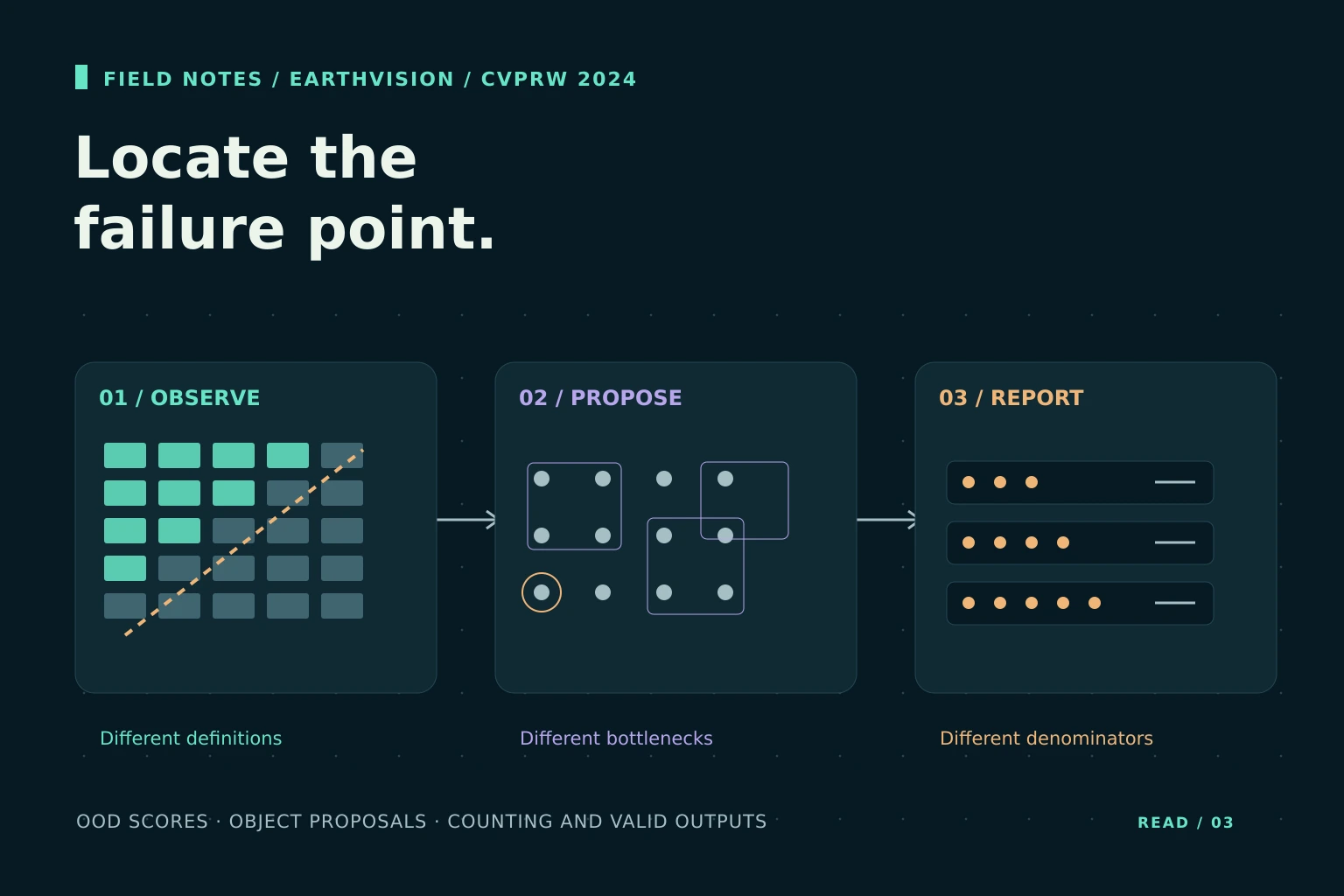
The useful connection between these papers is the location of failure. An OOD detector may respond to a difference other than the event of interest. A detector may have useful features but insufficient proposals. A VLM may recognize a scene while producing unusable coordinates or counts. Those are distinct hypotheses, and each calls for a different diagnostic rather than a larger model by default.
For a practical review, make a short pipeline map: acquired image, preprocessing, representation, candidate generation, prediction, parsing and decision. Attach the error to the earliest stage at which the needed information or valid output disappears. If several stages are plausible, preserve the uncertainty and design an ablation that separates them.
A small-object problem is a good example. First confirm that the object survives the image preparation. Next check whether it reaches the candidate set. Then examine whether its class is confused with a sibling category. Finally inspect how that prediction is turned into a user-facing count or report. A final accuracy value compresses these possibilities; a useful reading note restores them.
For HSI, the analogous review would also trace the wavelength axis, band masking and any spectral reduction. That is an editorial extension, not an experiment in these workshop papers. Keep the distinction visible when transferring an evaluation idea across sensor modalities.
What the public artifacts actually establish
The CVF collection supplies the selected papers; supplementary material is available for the few-shot and VLEO studies. The VLEO project links a dataset and its official code repository. The project page and repository listing were inspected, but their presence does not establish a complete current benchmark installation or the availability of every historical model endpoint. No model was queried for this article. [1][5][7]
A verified implementation repository for the diffusion OOD paper and the few-shot detector was not established in this reading pass. Their method descriptions are accessible, but a reproduction estimate should explicitly include implementation and data-preparation work until suitable artifacts are confirmed. This is an access status for these notes, not a claim that no code exists anywhere.
For the VLEO study, preserve the tested model identity and date if attempting a historical comparison. Substituting a newer endpoint changes the experiment. If an old system is unavailable, use a clearly labeled contemporary evaluation with the same task idea, and document every change in image handling, prompts, output parsing and scoring.
Do not redistribute paper figures or assume that a benchmark wrapper replaces the licenses of its source datasets. The artwork accompanying this guide is original schematic work. The paper links lead to the authors’ or proceedings’ own resources, and no protected figures or dataset images have been copied into the article.
Choose one follow-on question and make it falsifiable
For an OOD project, write a sentence defining the positive event, then list plausible nuisance changes that should not trigger it. Choose a validation procedure for the operating threshold and an evaluation group that reflects deployment. Report any proxy labels and the errors they can miss. The aim is to know what the detector would actually ask a person to review.
For a fine-grained detector, fix a scarce-label budget and inspect proposal coverage before changing the representation. Keep object size, category hierarchy and background conditions visible in the test analysis. A failure to separate similar subtypes should be reported differently from a failure to propose any object at all.
For a vision-language evaluation, define the expected output schema and denominator before collecting responses. Record abstentions, malformed outputs and wrong answers as distinct outcomes, while providing an explicit overall accounting. Use specialist baselines matched to the task if the purpose is a practical capability comparison.
These are proposed research checks, not newly measured results. A productive endpoint is a reviewed evaluation plan whose possible failure would change the conclusion. The workshop reading set is valuable because it turns broad questions about intelligence or robustness into narrower questions that can actually be answered.
Download this reading guide and original cover (ZIP)
Frequently asked questions
Which workshop and edition are covered?
Three papers from EarthVision in the CVPR 2024 Workshops proceedings. They are explicitly separate from the CVPR main conference.
Are these current 2026 VLM results?
No. The VLEO discussion reports a 2024 study of its named model versions. No current assistant or API was evaluated for these notes.
Why distinguish types of OOD?
A post-event image, a visible flood and a new geographic domain define different positive conditions. A detector’s score only makes sense relative to the selected condition.
Why inspect region proposals separately?
If a candidate box misses the target, a strong fine-grained classifier has no appropriate proposal to classify. The few-shot paper explicitly discusses this bottleneck.
Should invalid VLM outputs be discarded?
Keep them and state the scoring rule. Report answer correctness and coverage separately so a system cannot appear better solely because difficult cases disappeared.
Do these papers establish hyperspectral performance?
No. The guide transfers evaluation questions to HSI, while keeping the selected remote-sensing image protocols distinct from narrow-band spectral evidence.
References and further reading
- CVF: EarthVision, CVPR 2024 Workshops, official paper collection
- Le Bellier et al. Detecting Out-Of-Distribution Earth Observation Images with Diffusion Models. EarthVision, CVPR Workshops 2024; §§3–5.
- Bou et al. Exploring Robust Features for Few-Shot Object Detection in Satellite Imagery. EarthVision, CVPR Workshops 2024; §§3–4.
- Zhang and Wang. Good at Captioning, Bad at Counting: Benchmarking GPT-4V on Earth Observation Data. EarthVision, CVPR Workshops 2024; evaluation setup and §§3–4.
- VLEO-Bench official project: benchmark tasks and artifact links
- Zhang and Wang, CVPR Workshops 2024 supplementary: limitations, data sheet and task details
- VLEO-Bench official code repository linked from the project
Reader feedback
Reads since 1 October 2026: at least 15 seconds with the article visible, counted once per browser per day. Reactions are anonymous and can be changed.
Loading reader feedback…
Discuss this article
Ask a technical question, challenge an assumption or share evidence from your own work.