
Statistically Significant Nonsense · Episode 15
The lab, characters, dialogue and situations are fictional. The satire targets methodological habits and overclaiming, not named researchers or cited authors. Numerical examples are explicitly labelled illustrations, not measured benchmark results.
The laboratory has acquired a very selective archive
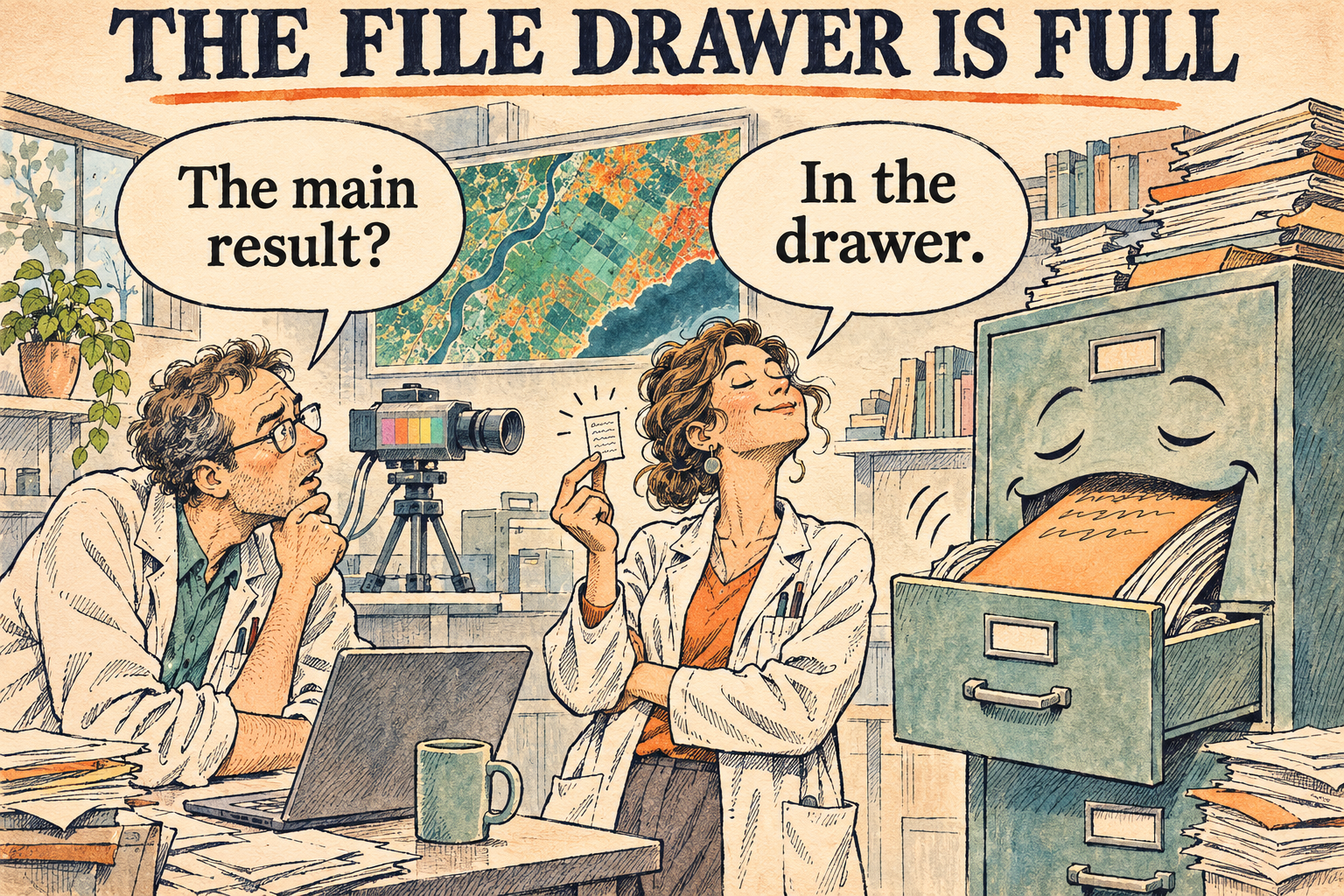
The fictional Centre for Promising Outcomes owns an unusually efficient filing cabinet. Positive findings go into the paper. Inconclusive findings go into the cabinet. The cabinet is now the largest experimental repository in the department, although it does not yet have a DOI.
“The method did not improve the primary metric,” says the student. “Did you check the subgroup?” asks the supervisor. “Which subgroup?” “We are open to suggestions.” The conversation is invented. The risk of selective visibility is a real research question.
Franco, Malhotra and Simonovits traced a defined collection of social-science experiments and found relationships between result strength, write-up and publication. [1] That study does not estimate publication bias in AI or HSI. It supplies evidence for a mechanism worth guarding against: the accessible literature can differ from the full set of conducted studies. Our cabinet is a metaphor, not an accusation that any cited author owns this furniture.
Sources: [1]
Before filing the result, check which experiment ran
The new spectral model performs badly. We prepare a brave negative paper exposing its limitations. Then someone checks the wavelength order. The bands have been supplied backwards. Apparently the method's main limitation is our data loader.
A failed implementation, an imprecise comparison, a small effect and a verified adverse effect require different conclusions. Check label mappings, units, loss reduction, gradient updates and checkpoint loading. In HSI, verify spectral order, preprocessing scope and spatial support. Confirm that a credible reference system behaves plausibly. These checks reduce obvious alternative explanations; they do not prove an implementation flawless.
Pineau and colleagues describe practices supporting reproducible computational evidence. [2] Negative reports deserve the same care as favourable ones. If a reproduction remains unresolved, report the discrepancy and its limits. The cabinet should not contain genuine evidence merely because it disappoints, but neither should the conference receive a theory of architectural failure that is actually a channel permutation.
Sources: [2]
The smallest meaningful effect has not yet been negotiated
The lab says the improvement is negligible. How small would an effect have to be for that judgement? “Smaller than the one we hoped for,” comes the answer. This is an understandable emotional threshold and a poor statistical specification.
Define the comparison, target population, primary metric and smallest effect that would matter to the application. For an HSI system, a rare-class recall change may be consequential even when overall accuracy barely moves. Physical concentration errors, object counts and percentage points require different interpretations. A threshold should reflect the task and measurement uncertainty, not the estimate that happened to arrive.
Symmetric equivalence bounds may suit some questions; asymmetric costs or a non-inferiority question may suit others. State the justification and consider sensitivity to plausible bounds. A tightly estimated negligible difference can guide a decision. An uncertain estimate near zero may leave important benefits and harms unresolved. Both deserve better labels than the cabinet's current taxonomy of “exciting” and “miscellaneous”.
Not significant is not a certificate of identicalness
The institute receives a large p-value and announces that the methods are equivalent. It has mistaken failure to reject a difference for evidence that meaningful differences are absent. Lakens explains equivalence testing with prespecified bounds for effects too small to matter. For the standard two one-sided tests procedure at alpha 0.05, an appropriate 90% confidence interval must lie entirely inside those bounds, subject to the test's assumptions. [3]
Our table uses invented intervals and bounds of minus 0.5 to plus 0.5 percentage points. An interval from minus 1.8 to plus 2.0 leaves practically important effects unresolved. An interval from minus 0.15 to plus 0.10 lies inside the bounds and supports equivalence under that procedure. These are illustrations, not observed results.
Neither interval establishes identical predictions, costs or performance elsewhere. The cabinet has requested a label printer. We suggest “inconclusive” and “equivalent within these bounds” rather than its preferred single drawer marked “nothing happened”.
| Illustrative interval | Relation to bounds | Interpretation |
|---|---|---|
| −1.8 to +2.0 points | Extends beyond both bounds | Important effects remain unresolved |
| −0.15 to +0.10 points | Entirely within both bounds | Supports practical equivalence under assumptions |
Sources: [3]
The preregistration is dated suspiciously after the revelation
The lab writes a beautifully specific hypothesis after discovering which metric improved. It is specific because the data have helpfully supplied the answer. The document is then described as the original plan, which is efficient if one is unconcerned about the direction of time.
Record the primary comparison, analysis, exclusions and stopping rule before relevant outcomes are inspected where feasible. Nosek and colleagues describe preregistration as distinguishing prediction from postdiction. [4] It does not prohibit exploration, and it does not repair a poor design merely by preserving it early.
For existing benchmarks, disclose prior knowledge. Record amendments with their timing and reasons. Exploratory analyses can be valuable when labelled as such, especially when they motivate a separately planned follow-up. The cabinet's preferred workflow is to rewrite the original question until the disappointing result answers a more attractive one. A timestamped plan makes that renovation harder to mistake for the building's original architecture.
Sources: [4]
The appendix contains every run that survived the audition
Our final configuration emerged from many attempts, but the paper begins at the moment it became presentable. Failed searches, discarded metrics and inconvenient subsets have been relocated to the cabinet. The resulting narrative has excellent pacing and questionable experimental provenance.
Preserve the consequential search and analysis history: attempted variants, budgets, failures and decisions that affected which outcomes could be selected. This does not require publishing every temporary syntax error. It requires enough history to understand the scientific opportunities for selection.
Simmons, Nelson and Simonsohn demonstrate how undisclosed analytic and data-collection flexibility can inflate false positives in their psychology study. [5] Its numerical findings should not be transplanted into AI. The practical lesson is transparency about flexibility. State whether the negative finding came from a predeclared collection or was selected after other settings differed. A bounded unsuccessful configuration is useful evidence. It should not be presented as a universal verdict simply because the other folders are less convenient.
Sources: [5]
A diagnostic result is allowed to remain a diagnostic result
After an unfavourable primary outcome, the lab examines rare classes, learning curves and sensor differences. This is sensible. Then one subgroup looks promising, so the subgroup is promoted to the primary contribution and the original outcome becomes “preliminary”. The cabinet's human-resources department works quickly.
Use diagnostics to investigate optimisation failures, domain mismatch or unsuitable representations. For HSI, inspect spatial scale, spectral response, label quantity and acquisition conditions. Mark unplanned analyses as exploratory. A plausible explanation for a failure is a hypothesis requiring evidence, not a retroactive cancellation of the failure.
Report the original result alongside the diagnostic findings. Where possible, test the new explanation on independent data or in a separately planned study. A method may have a real, useful domain of success that the initial experiment obscured. The repair is to establish that domain honestly, rather than requiring the initial experiment to disappear for administrative reasons.
A useful negative report has more than a disappointed abstract
Write the question, tested conditions, estimate, uncertainty and practical implications. Show the implementation checks, comparison budget and credible baseline. Explain which observations would change the interpretation. Distinguish limitations of the study from limitations of the method; one difficult dataset cannot be appointed spokesperson for all possible acquisitions.
Release code, configurations and permitted evaluation artefacts. The benchmark release checklist provides a structure. If redistribution is restricted, give access instructions and a synthetic verification case for the software contract. That synthetic case can test mechanics without reproducing the empirical finding. A substitute dataset is not the same result wearing more convenient licensing.
The contribution may be a bounded failure condition, a strong baseline or a precision estimate that guides the next study. None requires declaring the entire idea worthless. Our fictional cabinet has been offered a new role storing printer paper, a product whose absence of significant findings is substantially less consequential.
The next experiment needs a question, not a happier ending
Different negative outcomes imply different next steps. Practical equivalence on the primary metric may favour a cheaper system if other requirements are satisfied. A wide interval may motivate more independent observations. An adverse effect may require a narrower application or revised method. An implementation fault needs engineering before another generalisation claim.
Identify the uncertainty that matters next. A new acquisition, stronger reference implementation or planned mechanism test may teach more than additional optimiser seeds on the same scene. State why the proposed follow-up addresses the unresolved question. Repeating experiments until the desired conclusion appears is not an especially economical research strategy, although it does keep the cabinet supplied.
The point is not to celebrate failure for its own sake. It is to preserve credible evidence regardless of whether it flatters the proposed method. A disappointing result with a clear scope can save another group substantial work. A selectively silent result mainly improves the laboratory's furniture statistics.
Frequently asked questions
Does a large p-value show that two methods are equivalent?
No. It can reflect limited precision. Equivalence requires meaningful prespecified bounds and an analysis appropriate to the design and outcome.
Can exploratory analyses follow a preregistered study?
Yes. Label them as exploratory, retain the planned results and explain any changes. A later independent test can assess hypotheses generated by the exploration.
Is a failed reproduction a negative scientific result?
It can be useful evidence about reproducibility, but unresolved implementation or protocol differences limit conclusions about the original substantive claim.
References and further reading
- Franco, Malhotra and Simonovits (2014). Publication bias in the social sciences: Unlocking the file drawer. Stanford author repository.
- Pineau et al. (2021). Improving Reproducibility in Machine Learning Research.
- Lakens (2017). Equivalence Tests: A Practical Primer for t Tests, Correlations, and Meta-Analyses.
- Nosek et al. (2018). The preregistration revolution.
- Simmons, Nelson and Simonsohn (2011). False-positive psychology: undisclosed flexibility in data collection and analysis allows presenting anything as significant.
Reader feedback
Reads since 1 October 2026: at least 15 seconds with the article visible, counted once per browser per day. Reactions are anonymous and can be changed.
Loading reader feedback…
Discuss this article
Ask a technical question, challenge an assumption or share evidence from your own work.