
A release should let another researcher inspect the claim
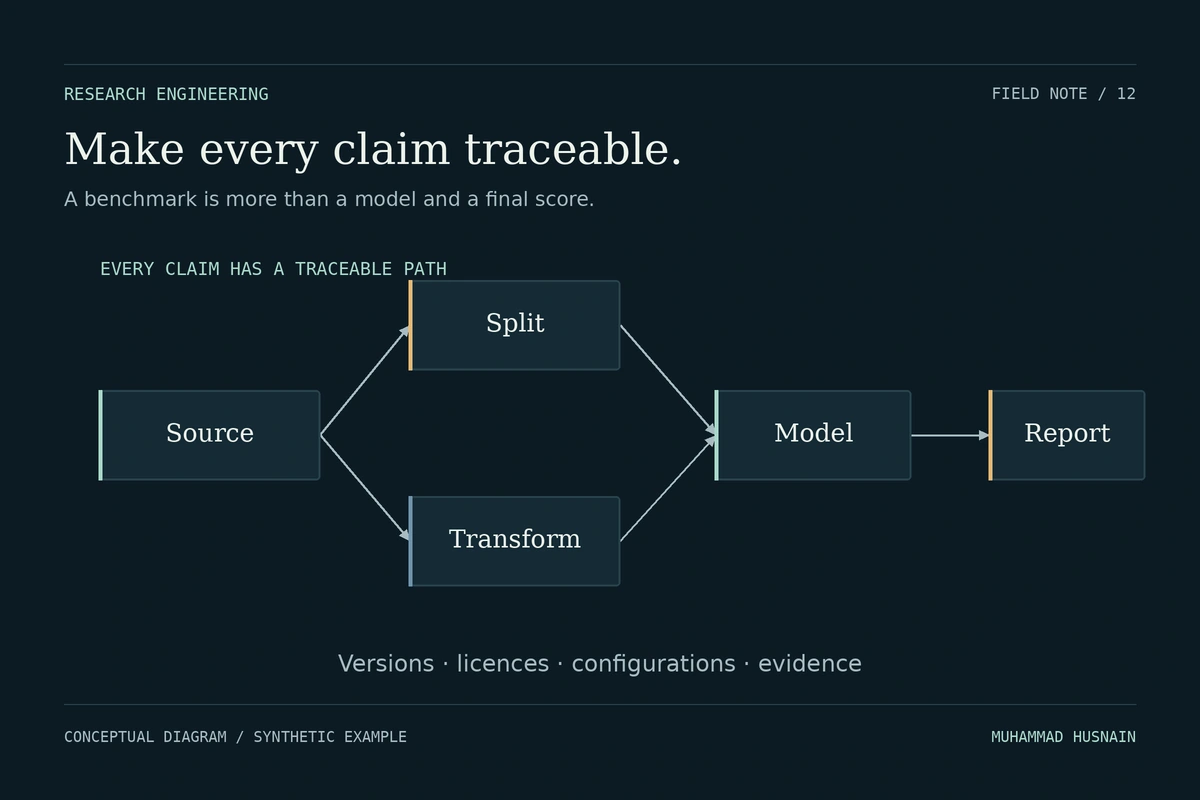
A benchmark release is more than a code repository and a table of scores. It is an argument that particular measurements, labels, partitions and evaluation rules support a stated comparison. The release should make that argument traceable without relying on the author’s memory or private working directory.
The NeurIPS checklist asks authors to align claims with evidence and describe reproducibility, experimental details, uncertainty, compute and asset licences. Those questions provide a useful review framework even when preparing work for another venue. They are not a guarantee that an experiment is correct or a substitute for the destination venue’s current instructions. [1]
This article proposes a practical release structure for HSI studies. It extends the reproducible pipeline guide from executing one analysis to supporting a comparison that other researchers can audit and reuse.
Start with a claim register
Write each headline claim in a row beside the experiment that supports it. “Improves overall accuracy”, “preserves small objects”, “uses fewer labels” and “transfers to another sensor” are different claims. They need different metrics, denominators, data partitions and control conditions.
For each row, list the input dataset version, split identifier, model configuration, checkpoint-selection rule, evaluator version and result file. Include the comparison budget and known limitation. If a claim has no corresponding result artefact, either produce the evidence or narrow the text.
A synthetic example can establish a controlled failure mechanism without establishing real-world performance. A successful software smoke test can establish that a command runs without establishing a reproduced paper score. Give each result an evidence label and retain that label in figures, documentation and release notes.
| Claim | Minimum linked evidence | Common mismatch |
|---|---|---|
| Small-object preservation | Object definition, fixed subset, predictions and metrics | Only reporting overall accuracy |
| Label efficiency | Annotation unit, budgets, repeated selections and matched baselines | Counting pixels while ignoring object labels |
| Sensor transfer | Source/target contracts and held-out target evaluation | Testing on a resampled source scene |
| Faster execution | Hardware, timing boundary, precision and memory record | Comparing different workloads |
Preserve the data lineage without republishing blindly
Identify the original data provider, version or acquisition, files used and checksums. Record preprocessing transformations in execution order, including radiometric scaling, band removal, spatial resampling and annotation conversion. A citation alone may not identify the exact bytes used when a provider updates a package.
Keep source data immutable within the workflow. Derived arrays should point back to their inputs and transformation settings. If a hand-edited label correction is necessary, store a reviewable change record rather than overwriting the original annotation. Another researcher should be able to distinguish provider labels, corrections and algorithm-generated pseudo-labels.
Sandve and colleagues recommend tracing computational results to their inputs and preserving the software and intermediate steps needed to recreate them. Applied here, that means a final prediction map should lead back to its checkpoint, preprocessing state and scene manifest, rather than merely sharing a folder name with them. [2]
Release the partition as data
Publish explicit sample or region identifiers for training, validation and test where redistribution rules allow. A random seed is useful but not sufficient if library behaviour, input ordering or filtering changes. Preserve the algorithm that generated the partition as well as its realised output.
For spatial models, document receptive support, patch sizes and any exclusion buffer. Show how objects, fields, scenes or specimens remain separated at the level required by the claim. Labelled pixel centres can be disjoint while the underlying image patches overlap. Include a compact assertion that fails when the intended separation is violated.
Treat preprocessing fit scope as part of the partition. Scaling, dimensionality reduction, feature selection and calibration fitted to data must identify which subset they used. A transform computed on the whole image is not automatically invalid for every transductive task, but the access assumption must match the claim and the competing methods. See spatial splits and leakage for the distinction.
Expose model selection and unsuccessful runs
Record the search space, validation objective, stopping rule and number of completed trials. State whether methods received comparable tuning effort and how failed or interrupted runs were handled. Selecting the best test score from many checkpoints makes the test part of development.
A compact run ledger can contain one row per attempted configuration, including failures and the reason for exclusion. Keep the final aggregate table generated from that ledger and the saved evaluator output. Manual spreadsheet edits should not be the only connection between a paper number and an experiment.
For repeated runs, distinguish variability from optimisation randomness, data partitioning and independently acquired scenes. Averaging several seeds on one scene does not measure between-scene generalisation. Choose an uncertainty analysis that reflects the sampling unit and explain what remains unmeasured.
Make the evaluator harder to misuse
Define the class mapping, ignored labels, no-data policy, aggregation rule and units beside the evaluator. Specify whether macro metrics average over all declared classes or only classes present in a subset. Record the convention for undefined ratios rather than silently replacing every undefined quantity with zero.
Include small fixtures with manually checkable results: a perfect prediction, a missing class, an empty valid mask and a boundary case. For object metrics, add examples involving one merged object and one split object. These tests should protect the scientific definition, not just repeat the implementation in a second function.
Release sufficient intermediate counts to recompute summary metrics when possible. A confusion matrix, valid sample count and per-class support make an accuracy table more interpretable. They still do not reveal spatial errors, so retain appropriately shareable prediction maps or object records as well.
Separate a rerun recipe from a universal guarantee
Provide an exact source revision, dependency lock or environment specification, hardware description and commands for a small verification run and the reported experiment. Record expected outputs with tolerances where exact equality is inappropriate. State which commands were actually executed by the release author.
PyTorch explicitly warns that full reproducibility is not guaranteed across releases and platforms, or between CPU and GPU even with identical seeds. Document random-number handling, deterministic settings and relevant precision choices. An environment file narrows ambiguity but cannot make every future device numerically identical. [3]
A useful independent check starts from a clean directory and follows the public instructions without private caches. Record missing files, manual interventions, runtime and whether the expected artefacts were recovered. If the full benchmark is too costly to rerun, say exactly what the verification run covers and which larger results remain unverified.
Describe what can actually be reused
List the licence or access terms separately for code, datasets, annotations, weights and imported assets. Having permission to download an asset does not automatically imply permission to redistribute it. When redistribution is restricted, provide the legitimate acquisition route and an input-verification step instead of bundling a private copy.
The FAIR principles emphasise persistent identification, rich metadata, provenance and clear reuse terms. Accessibility can include a specified authentication or authorisation process; FAIR should not be casually equated with unrestricted public download. Use the principles to improve the release record, without claiming formal compliance from a checklist alone. [4]
Scan the release for private paths, credentials, personal records and material unrelated to the public experiment. This is a review of the actual package, including notebooks and logs, not just the top-level source files. Preserve attribution and the original licence notices for included third-party components.
Make the final release immutable and reviewable
Create a versioned release with checksums and a concise change log. Keep a stable record of which paper table belongs to which release. Correcting a metric implementation should create a new version with an explanation of affected results, rather than silently changing the evidence behind an existing citation.
Before publication, ask whether a colleague can identify the data, reconstruct the split, load the declared state, run the evaluator and understand the claim’s limits. Those are concrete acceptance criteria. They are stronger than a statement that the repository “should work”, and modest enough to verify honestly.
Use experiment tracking during development to keep this release work manageable. The best time to preserve lineage is when an experiment runs; reconstructing it after hundreds of trials is slower and less reliable.
Frequently asked questions
Is a seed enough to reproduce an HSI benchmark?
No. Preserve realised splits, input versions, source revision, fitted preprocessing, model-selection rules and evaluator settings. Seeds do not fix every dependency or platform difference.
Must every dataset be redistributed?
No. Follow its actual licence and access terms. A reproducible release can provide a legitimate acquisition procedure and checksums when bundling the data is not permitted.
Does a passing smoke test reproduce the reported score?
Only if it executes and checks that reported experiment. A small fixture can verify installation and basic behaviour while leaving the complete benchmark untested.
References and further reading
Reader feedback
Reads since 1 October 2026: at least 15 seconds with the article visible, counted once per browser per day. Reactions are anonymous and can be changed.
Loading reader feedback…
Discuss this article
Ask a technical question, challenge an assumption or share evidence from your own work.