
Statistically Significant Nonsense · Episode 19
The lab, characters and dialogue are fictional. The satire concerns methodological overclaiming, not the cited researchers. Numerical examples are explicitly constructed illustrations, not findings from an unpublished experiment.
The stamp is larger than the evidence
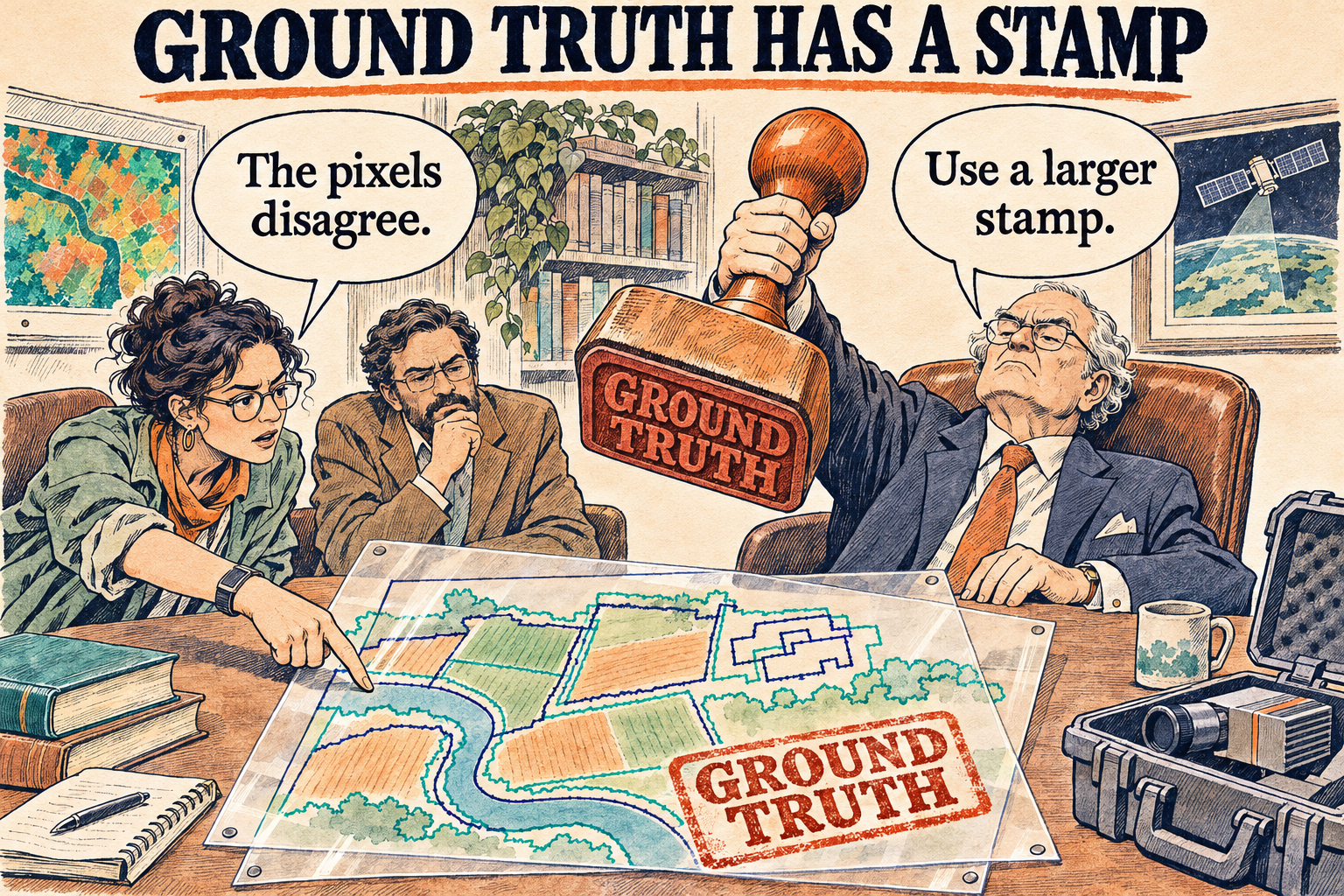
At our fictional remote-sensing lab, the reference raster is called ground truth. This title gives it immediate seniority over the field notes, the acquisition date and the inconvenient boundary running through half the pixel. When the two maps disagree, someone suggests checking their registration. The committee orders a larger GROUND TRUTH stamp. Administrative certainty has excellent spatial resolution.
A label is an operational definition implemented through measurement and annotation. Jacobs and Wallach explain why the relationship between a theoretical construct and its operationalisation needs explicit attention [1]. Their analysis concerns computational fairness; the relevant principle here is measurement validity, not an empirical finding about this imaginary raster. A familiar file name cannot complete that argument on its own.
Reviewer: “What does positive mean?” Author: “Target.” Reviewer: “Any target material, dominant material, or an object's footprint?” Author: “The green pixels.” Those alternatives can produce different correct labels for a mixed pixel. Define the intended quantity before deciding that every disagreement is a mistake. A colour table is a display convention, not an ontology, although it does look authoritative projected across an entire meeting room.
Sources: [1]
The field survey happened in a different tense
The reference committee presents an immaculate polygon. Its source image was acquired before harvesting; the hyperspectral image was acquired afterwards. The classifier is now accused of misunderstanding crop cover when it may be observing a different crop-cover state. Reviewer: “When was the reference collected?” Author: “Before we downloaded it.” An acquisition date and a download date are not interchangeable methods details.
Document the source, timing, resolution and interpretation procedure behind the labels. A field survey, laboratory assay, expert interpretation and high-resolution image each supply different evidence. Record annotation instructions, uncertainty and adjudication. A fine-resolution boundary transferred onto a coarse grid also needs an aggregation rule and defensible spatial alignment. Resampling cannot decide whether a trace constituent should count as a positive label.
Olofsson and colleagues connect sampling design, response design and analysis in map assessment [2]. The reference protocol belongs beside the evaluation statistic. A perfectly computed confusion matrix can faithfully summarise the wrong target. Our fictional lab's matrix has six decimal places, which is impressive until the technician discovers that the two datasets disagree about which side of the road contains the field.
Sources: [2]
Every disagreement cannot be a clerical error
The model and reference disagree. The author proposes a universal repair: rename every disagreement label noise. This is efficient, because it makes the model correct without another training run. It is also uninformative. The model can be wrong, the reference can be wrong, or both can inadequately represent the underlying condition. An audit needs room for all three, including cases the available evidence cannot resolve.
Separate transcription mistakes, ontology ambiguity, mixed-pixel composition, temporal change and registration error. They call for different remedies. Checking the original record can repair transcription. It cannot decide whether the application requires any-presence or dominant-cover labels. Reassigning a class cannot necessarily fix a polygon displaced by several metres. The committee should identify the problem before selecting its favourite correction button.
Agreement among annotators measures consistency under a procedure, not complete validity. Five people can consistently apply the same unsuitable definition. Conversely, disagreement can reveal a real ambiguity concealed by a hard label. Reviewer: “They all agreed.” Author: “They used the same handbook.” Reviewer: “Did the handbook answer the application question?” The handbook has been asked to attend the next meeting.
Twenty mixed pixels request a definition
Consider a synthetic set of 100 coarse pixels: forty contain no target material, forty are predominantly target, and twenty contain a small target fraction. Any-presence labelling produces 60 positives. Dominant-material labelling produces 40. Both annotators can know the material fractions exactly and still disagree on twenty labels because they are answering different questions. Nobody needs to be careless for this example to work.
A classifier perfectly matching the dominant-material definition has 40 true positives, 20 false negatives and 40 true negatives when evaluated against the any-presence reference. Its apparent recall is 40/60, approximately 66.7%, and accuracy is 80%. The fictional author writes “annotation noise degraded performance”. Reviewer: “Or your evaluation changed the meaning of positive.” The twenty pixels have not moved. The target definition has.
These are constructed counts, not measured benchmark results. Neither definition is universally superior. Searching for hazardous-material presence and making a dominant land-cover map can reasonably require different targets. Align the definition with the decision, retain the conversion rule and report the distinction. The remedy is not to choose whichever ontology lets the proposed network enjoy a more comfortable afternoon.
| Pixel composition | Count | Any-presence label | Dominant-material label |
|---|---|---|---|
| No target material | 40 | Negative | Negative |
| Predominantly target | 40 | Positive | Positive |
| Small target fraction | 20 | Positive | Negative |
The model has nominated its own answer key
An automated audit flags suspicious labels using predicted probabilities. The lab immediately replaces them with the model's preferred classes. Reviewer: “Who adjudicated the disagreements?” Author: “The disagreeing party.” That procedure can reproduce the model's preferences in the reference, particularly on rare classes and unfamiliar conditions where confident predictions need not be reliable. A high disagreement score is a useful invitation to review, not a certificate of clerical guilt.
Northcutt, Jiang and Chuang's confident-learning framework studies label quality under a class-conditional noise assumption and provides conditions supporting its estimates [3]. Those assumptions deserve to remain attached when the method reaches a new dataset. The software does not automatically determine whether a mixed pixel, temporal change or difficult boundary belongs to the same error model.
Use independent evidence where feasible, retain original labels and document why each accepted correction was made. If estimating whole-dataset error prevalence, review an appropriate sample of unflagged records too or account for the selection scheme. Inspecting only the suspicious queue can find real problems. It cannot tell the committee how common those problems are among all records simply by dividing by the queue length.
Sources: [3]
The benchmark revision needs a version number
Northcutt, Athalye and Mueller identify and human-validate test-label errors and investigate their consequences for model comparisons [4]. Their findings show why reference quality matters. They do not supply a universal correction rate for every future hyperspectral dataset. Our fictional author cannot borrow a published error percentage and apply it to the local scene like a radiometric calibration coefficient.
Freeze an adjudication protocol before inspecting final rankings where possible. Hide model identity from reviewers when feasible, provide the original evidence, and retain uncertainty, disagreement and exclusions. The scientific question is which label the evidence supports. “The proposed method wins under this revision” is not an annotation criterion, even if everyone in the meeting finds it pleasantly decisive.
Publish original-reference and corrected-reference results when that helps continuity, and identify changes to ontology, support or population. A corrected release is a benchmark version. Reviewer: “Which labels produced this table?” Author: “The current ones.” Reviewer: “Current before or after the previous table?” Version identifiers are particularly helpful when memory starts optimising itself for the camera-ready narrative.
Sources: [4]
Majority voting cannot sharpen a mixed pixel
The committee tries adding more annotators. This can help in some settings, but it does not guarantee that every target has a single unambiguous answer. Pavlick and Kwiatkowski show that disagreements in natural-language inference can persist and need not all be dismissed as annotation noise [5]. Their empirical domain is language. The transferable question is whether disagreement reflects a task ambiguity that a vote merely conceals.
For remote sensing, finite spatial support and registration uncertainty can make boundaries genuinely uncertain. Fractional targets, acceptable label sets or uncertainty flags may represent the available evidence better, if they match the intended task. The correct choice depends on what the model must predict. There is no obligation to make every task probabilistic simply because the boundary is difficult to draw.
Specify how uncertain cases enter training and assessment. Deleting them changes the population and can remove precisely the mixed boundaries or small objects the paper claims to handle. Author: “Our boundary performance is excellent.” Reviewer: “Where are the boundaries?” Author: “Excluded for quality.” That is an evaluation of the retained interiors, which may be useful but deserves its actual name.
Sources: [5]
A reference standard that can answer questions
The final release includes the target definition, annotation instructions, evidence sources, transformations, adjudication procedure, version identifiers and known limitations. The stamp has been retained for ceremonial occasions. The useful authority now comes from a record that lets another researcher reconstruct what a positive label means. Selected example images are no longer required to carry the entire ontology through visual suggestion.
The evaluation names its reference version and population, shows difficult-class support and distinguishes reference uncertainty from model uncertainty. A classifier's confidence is not confidence in the underlying measurement. Nor does documenting limitations imply that all labels are unreliable. Good reference data are valuable precisely because their meaning and acquisition process can be examined, not because they are exempt from questions.
Reviewer: “So is this ground truth?” Author: “It is our documented reference standard for this target definition.” The meeting becomes briefly less dramatic and considerably more useful. A later analyst can now discover whether apparent disagreement concerns model error, changing land cover or a different operational target. Meanwhile the oversized stamp remains perfectly reproducible, provided nobody mistakes its ink density for evidence.
Frequently asked questions
Is agreement between annotators enough to validate the target?
No. Agreement establishes consistency under the annotation procedure. The procedure must also represent the scientific construct and deployment decision that the model is intended to support.
Can an automated detector replace incorrect test labels?
It can prioritise review, but model disagreement is not proof of a reference error. Adjudication should use independent evidence, preserve original labels and document uncertainty and benchmark version changes.
Should uncertain boundary pixels be excluded?
Only under an explicit evaluation definition. Exclusion changes the population and can remove the difficult cases central to the claim. Report what was excluded and avoid extending the result to those cases without evidence.
References and further reading
- Jacobs and Wallach (2021): Measurement and Fairness. FAccT, 375–385.
- Olofsson et al. (2014): Good practices for estimating area and assessing accuracy of land change. Remote Sensing of Environment, 148, 42–57.
- Northcutt, Jiang and Chuang (2021): Confident Learning: Estimating Uncertainty in Dataset Labels. JAIR, 70, 1373–1411.
- Northcutt, Athalye and Mueller (2021): Pervasive Label Errors in Test Sets Destabilize Machine Learning Benchmarks. NeurIPS Datasets and Benchmarks.
- Pavlick and Kwiatkowski (2019): Inherent Disagreements in Human Textual Inferences. TACL, 7, 677–694.
Reader feedback
Reads since 1 October 2026: at least 15 seconds with the article visible, counted once per browser per day. Reactions are anonymous and can be changed.
Loading reader feedback…
Discuss this article
Ask a technical question, challenge an assumption or share evidence from your own work.