
Statistically Significant Nonsense · Episode 13
The lab, characters, dialogue and situations are fictional. The satire targets methodological habits and overclaiming, not named researchers or cited authors. Numerical examples are explicitly labelled illustrations, not measured benchmark results.
The fairness committee has counted to twenty
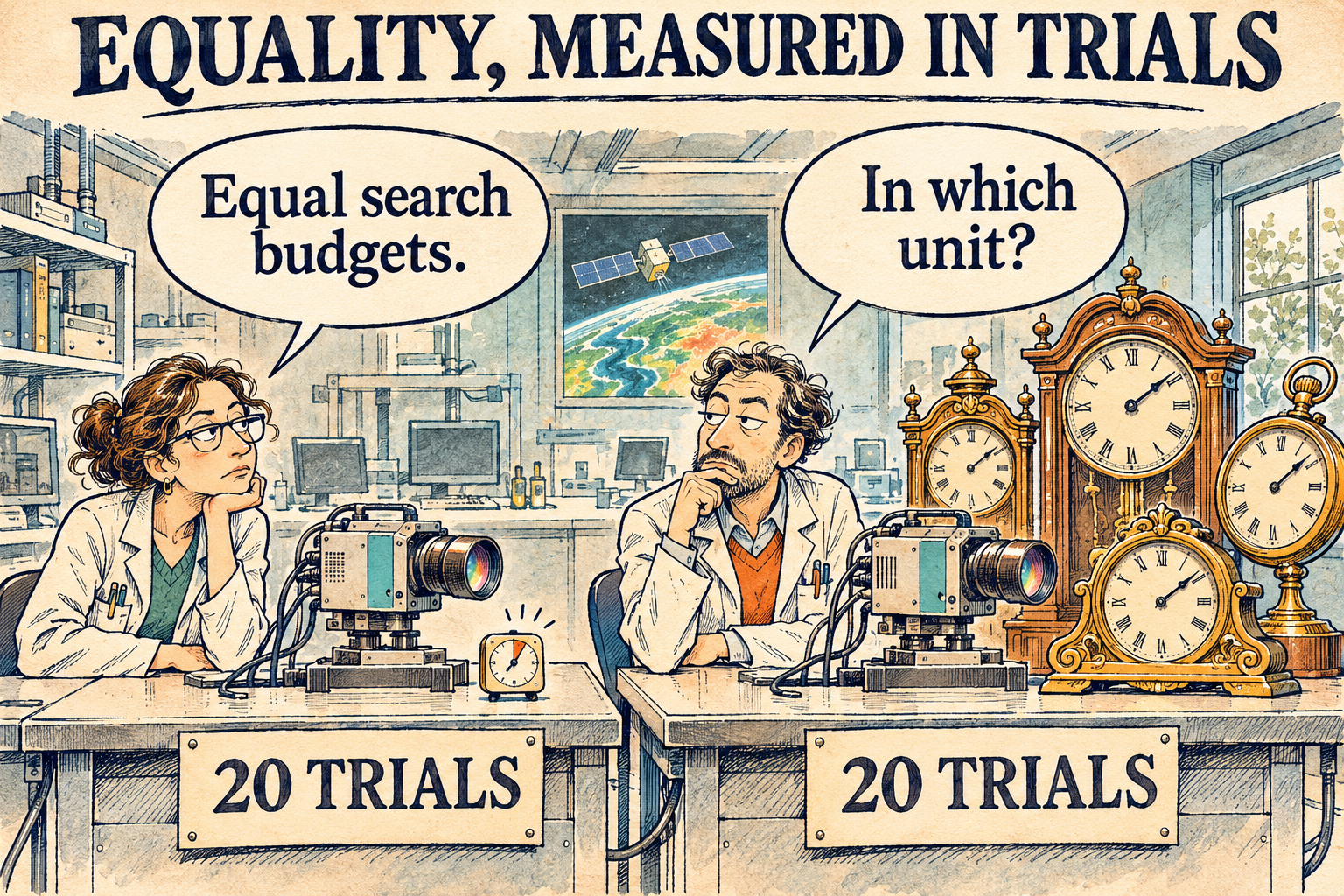
The fictional Remote-Sensing Benchmark Committee has achieved equality. Every method gets twenty trials. One trial takes fifteen minutes for the baseline and an hour for the proposed model, but time is a social construct when the table has already been formatted.
“We matched the budget,” says the committee. “Which budget?” asks the engineer. A silence follows, during which the proposed model completes another validation pass on its larger accelerator.
A comparison concerns complete procedures: data access, preprocessing, training, search and selection. Specify whether the question is a common-recipe architectural comparison, the best quality within a resource limit or practical performance with available pretrained systems. Dodge and colleagues explain why results should be reported with search effort and resource budgets. [1] Equal trial counts can be a valid design. The comedy starts when one valid equality is asked to impersonate every other kind.
Sources: [1]
The baseline has been found in a cupboard
Our baseline repository has not been opened since the optimiser defaults changed. Its checkpoint is missing, the band order is uncertain and the README says “coming soon”. We run it once, obtain a disappointing result and announce that the field has moved on. It has mostly moved on from the setup instructions.
Identify the implementation revision, weights, original protocol and adaptations. Attempt the documented reference configuration and investigate substantial discrepancies. Keep an authors' original configuration separate from a harmonised version. Updating a backbone or optimiser creates a modified baseline; naming that change is much cheaper than making readers discover it.
Musgrave and colleagues examine methodological problems in metric learning comparisons, while Chen and colleagues study backbone and implementation choices in few-shot classification. [2][3] These are not HSI performance results. They are reasons to give a baseline a credible opportunity before declaring it scientifically deceased. A method cannot fairly lose a competition in which its data loader is wearing the wrong shoes.
Both methods received the same labels and different planets
The label counts match exactly. The proposed system also received external pretraining, the unlabelled target scene and a graph connecting every test pixel to its neighbours. The baseline received a CSV and encouragement. “Same supervision,” says the committee, carefully looking at the only column where that statement fits.
Record external data, pretraining, target-scene access, spatial context and fitted statistics. Transductive access may be entirely appropriate for mapping a known scene. It must be part of the declared task, with a comparable opportunity for alternatives or an explicit account of the difference. Target information does not become invisible merely because it lacks a class label.
Audit preprocessing as well. The scikit-learn documentation demonstrates leakage through transformations fitted using test data. [4] In HSI, inspect PCA, normalisation, band selection and patch footprints. The spatial-split guide addresses overlapping support. A fair information budget requires more than proving that both spreadsheets contain the same number of annotations.
Sources: [4]
The accountant has brought a calculator
The table is a hypothetical accounting example on one device, excluding overhead and failures solely to keep the arithmetic transparent. Twenty baseline trials at fifteen minutes take five device-hours. Twenty proposed-method trials at sixty minutes take twenty device-hours. At twenty hours, the reference procedure could instead complete eighty such trials. No accuracy advantage is implied by any of these numbers.
The committee objects that eighty trials sounds unfair. It is unfair to the story in which twenty automatically meant equal resources. Trial-matched and time-matched comparisons answer different questions. Report the design that serves the research question and, where useful, show performance across budgets. [1]
Also disclose search ranges, sampling distributions, early termination and failed attempts. Twenty trials over one learning rate are not the same exploration as twenty architecture searches. Hardware and implementation affect runtime. There is no universal budget currency, but there is a perfectly serviceable obligation to name the currency being spent.
| Procedure | Time per trial | Trials | Total device time |
|---|---|---|---|
| Reference search | 15 minutes | 20 | 5 hours |
| Proposed search | 60 minutes | 20 | 20 hours |
| Reference at 20 hours | 15 minutes | 80 | 20 hours |
Sources: [1]
An epoch is a unit of local custom
Next the committee equalises epochs. Both models train for fifty. Unfortunately, their effective batch sizes differ. For a hypothetical dataset of 10,000 examples with no dropped remainder, batches of 50 give 200 updates per epoch; batches of 100 give 100. Fifty epochs produce 10,000 versus 5,000 parameter updates. The epoch counts are identical. The optimiser has noticed the difference.
Equal epochs preserve example presentations under these assumptions, not update counts. Record batch size, gradient accumulation, updates, examples processed and stopping rules. In patch sampling with replacement, an epoch may be a number someone selected because the progress bar looked reasonable. Publish that convention.
Distinguish fixed-work training from time to a predefined quality target. Both can matter. A method reaching an acceptable result quickly may be useful even if another later scores higher. “Faster” needs the finish line, not just a stopwatch and a persuasive font.
Checkpoint selection is also a resource
The proposed model is inspected every hundred updates. The baseline is evaluated when its run ends, like a relative everyone remembers to telephone at Christmas. We select the best proposed checkpoint and compare it with the baseline's final state. The committee calls this a common training protocol because both used electricity.
Declare validation frequency, selection metric, tie rules and search limits. State whether the final estimate concerns one selected configuration or repetitions of the entire selection procedure. Keep final test labels outside this loop. Calling it a test set does not stop it functioning as validation once its scores guide choices.
Record divergence, out-of-memory failures and infrastructure interruptions. Apply a predeclared restart and exclusion policy. Failed attempts consume resources; numerical instability is part of practical reliability. Quietly deleting unsuccessful trials can make a fragile method appear both robust and economical, which is an impressive two-for-one offer from the accounting department.
The simple baseline has learned the new recipe
A modest spectral classifier appears at the meeting. It has appropriate preprocessing, a sensible search and no module named after celestial mechanics. This makes the committee uncomfortable. It may reveal that part of the proposed gain comes from the training recipe rather than the expensive spatial machinery.
Include simple systems that test the source of improvement, alongside credible recent methods. For a representation claim, a common-classifier comparison can complement the full-system result. For a spatial claim, describe each method's input footprint. These analyses isolate different changes; no single table must pretend to answer every question.
Transfer feasible training improvements to baselines in a clearly labelled experiment. Do not silently grant them only to the proposed method. Equally, recognise that one shared learning rate can disadvantage a legitimate alternative. Common-recipe and method-appropriate configurations are both useful when their questions and budgets are explicit. The simple baseline is not a nuisance. It is doing the work the contribution statement promised.
The losing scene has become an appendix problem
The method wins on two scenes and loses on a third. After reflection, the third scene is deemed “unrepresentative”. It was representative yesterday, before evaluation. The committee has discovered adaptive geography.
Declare the evaluation collection where feasible, explain exclusions and show scene-level outcomes. A pixel-pooled aggregate weights large scenes more heavily; an average of scene-level scores gives scenes equal weight. These summaries answer different questions. Report rare-class or object-level outcomes when the intended application needs them, rather than asking overall accuracy to speak on behalf of every roof and roadside tree.
The Benchmark Lottery documents changes in comparative rankings with benchmark selection. [5] It supports caution about scope, not nihilism about evaluation. A specialised method may legitimately excel in particular conditions. Identify those conditions and their practical value. “Best for these workloads” is useful information. “Best everywhere, except the place we removed” is a somewhat less stable research programme.
Sources: [5]
Minutes of the next committee meeting
Publish a comparison ledger with implementation revisions, information access, configurations, search histories, selection rules and resource measurements. Distinguish newly measured results from values quoted under other protocols. An imported paper score is contextual evidence until comparability has been established; putting it in the same column does not harmonise the experiment.
Retain material limitations, including unavailable pretraining costs or unresolved reproduction gaps. Present accuracy, reliability and resource advantages as separate claims when they favour different systems. The reproducibility checklist helps connect the ledger to release artefacts.
Our fictional committee can now say exactly what it matched and what it did not. Some comparisons use equal trials, some equal device time, and others equal information access. None is magically complete. At least the accountant no longer needs to interrupt the presentation with the controversial observation that fifteen minutes and sixty minutes are different quantities.
Frequently asked questions
Is equal training time always the fairest comparison?
It is appropriate for a time-constrained question, provided hardware and timing boundaries are reported. Other questions may require matched data exposure, trial counts or quality targets.
Can I compare against numbers copied from a paper?
Yes, as contextual evidence with their original protocol clearly identified. They are not automatically controlled comparisons with your newly measured results.
Must a baseline use the same hyperparameters?
No. Common settings and independently tuned settings answer different questions. Declare the choice, justify it and document the optimisation resources given to each method.
References and further reading
- Dodge et al. (2019). Show Your Work: Improved Reporting of Experimental Results.
- Musgrave, Belongie and Lim (2020). A Metric Learning Reality Check.
- Chen et al. (2019). A Closer Look at Few-shot Classification.
- scikit-learn. Common pitfalls and recommended practices.
- Dehghani et al. (2021). The Benchmark Lottery.
Reader feedback
Reads since 1 October 2026: at least 15 seconds with the article visible, counted once per browser per day. Reactions are anonymous and can be changed.
Loading reader feedback…
Discuss this article
Ask a technical question, challenge an assumption or share evidence from your own work.