
Statistically Significant Nonsense · Episode 8
The laboratory, characters and dialogue are fictional. The target is methodological overclaiming, not any named researcher or benchmark. Cited papers provide evidence and important counterexamples; constructed workflows are not reported empirical findings.
The independent witness would like a salary
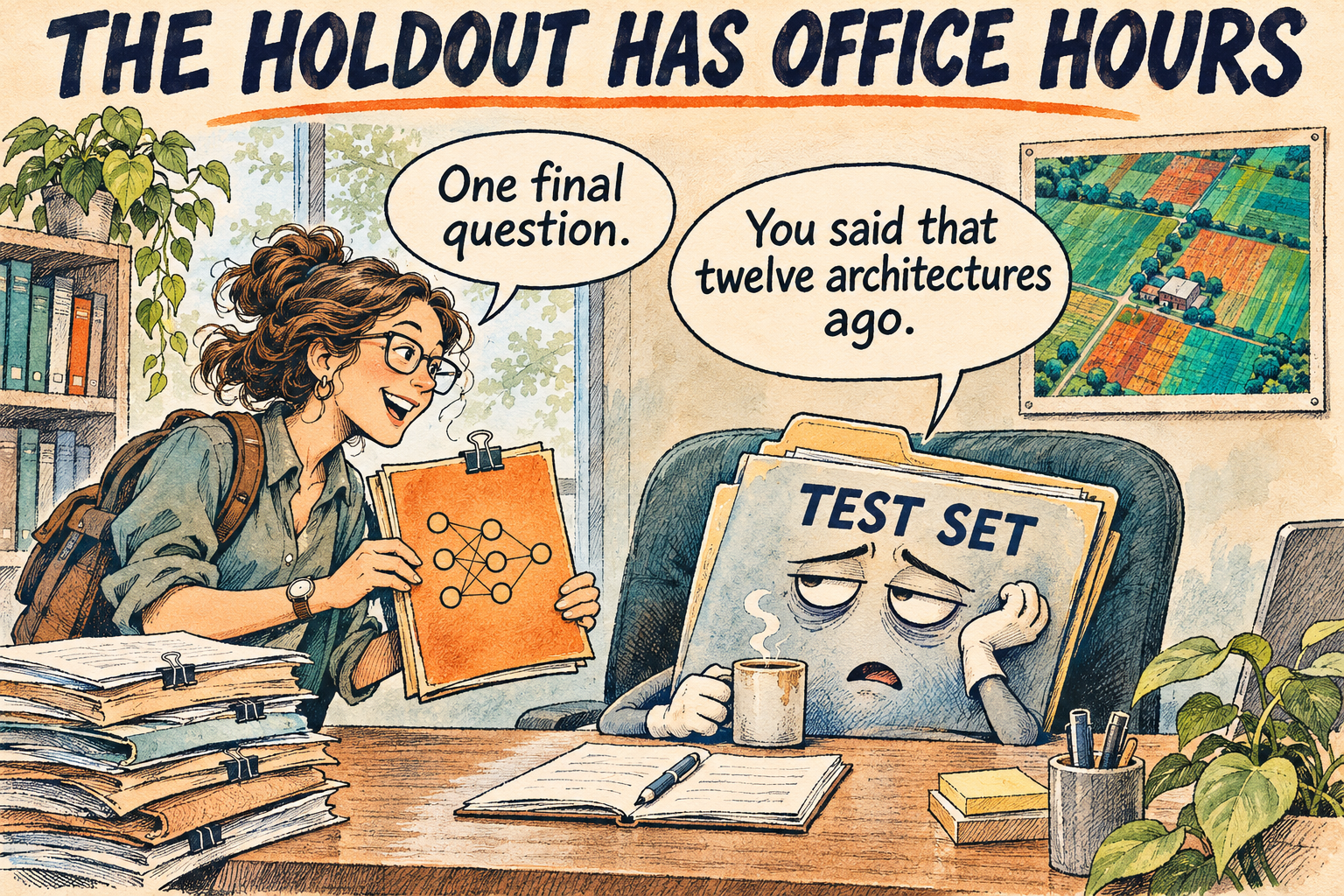
Our fictional test set was hired for one job: assess a finished model. It now attends weekly meetings, advises on patch size, identifies troublesome classes and gently suggests which morphological operation might improve the paper. Its contract still says independent witness. Its calendar says research supervisor.
Adaptive reuse occurs when information from evaluation results influences later analytical choices. That information can be a score, a leaderboard rank, a class breakdown or an error map. Nobody needs to download the labels and feed them directly into the optimiser. The model can learn from a human who learns from the test set. Humans remain surprisingly effective gradient-free feedback channels.
The relevant object is the decision history, not the partition name. A directory called test can perform validation duties all year. This episode's conversations are fictional. The methodological question is whether our supposedly independent witness has been helping write the testimony.
Apparently the labels never entered the GPU
In the lab meeting, someone offers the traditional defence: “The test labels never entered training.” Excellent. They merely changed the architecture, threshold and preprocessing through a researcher who could read the results. The GPU maintained its innocence while the rest of the procedure acquired information.
Direct leakage and adaptive reuse are distinct. Fitting on test labels is direct transfer. Repeatedly selecting designs for a better test score uses evaluation feedback. Inspecting difficult test images and inventing a tailored rule creates another channel. The consequences depend on the workflow; the distinction is not an invitation to assign everyone the same offence.
Dwork and colleagues formalise adaptive analysis and propose holdout-reuse mechanisms with stated guarantees. [1] Their result is not permission for unlimited ordinary inspection. Record which feedback was visible, who saw it and what changed afterwards. An access log is less emotionally satisfying than “we never touched the labels”, but substantially more informative.
Sources: [1]
Supervision and examination are different appointments
Development is allowed to involve failure, diagnosis and revision. That is why we have development data. Confirmation asks how a sufficiently specified procedure performs on information that did not direct those decisions. The two roles both contribute knowledge. They simply should not occupy the same chair while introducing themselves as strangers.
Suppose a constructed project tries twenty architectures on one public benchmark and keeps the highest-scoring one. The benchmark remains useful evidence about those observed candidates. The winning selection score alone does not independently confirm generalisation. For that stronger claim, seek an untouched sample or predefined external evaluation.
Freeze input processing, checkpoint selection, thresholds, classes and metrics as part of the confirmation specification. Freezing network weights while asking the test set to select the final postprocessing is like declaring the exam finished while continuing to edit the answers in a different pen.
The leaderboard has become a group chat
A public leaderboard is a feedback channel shared across submissions and researchers. In the fictional lab, each collaborator gets a modest submission allowance. They pool their results in one chat and congratulate themselves on restraint. The benchmark does not experience these as separate universes. It experiences a team asking more questions.
Blum and Hardt's Ladder framework addresses reliable leaderboard estimation under adaptivity. [2] It concerns a defined reporting mechanism and theoretical conditions. Rounding scores or limiting submissions does not automatically implement that guarantee. A padlock icon drawn beside the leaderboard is also unhelpful, although it may improve the slide.
Without a specialised service, use a development leaderboard and separately controlled confirmation set. Predefine eligible final submissions, preserve their order and scores, and minimise detailed confirmation feedback until analysis is complete. Apply the policy to the actual team process, including informal evaluations that somehow never make it into the official submission count.
Sources: [2]
An inconvenient result has entered the comedy
At this point a simpler article would announce that every reused benchmark is ruined. Unfortunately, the evidence has declined to support that punchline. Roelofs and colleagues compared public and private competition performance across more than one hundred machine-learning competitions and found little evidence of substantial overfitting in that sample. [3] The literature has interrupted our prosecution to request proportionality.
That does not make every benchmark immune. Dataset size, feedback rules, model correlations and competition procedures may differ from one small HSI study repeatedly examining one scene. Nor does a theoretical risk prove that a particular impressive score is substantially inflated.
Keep three statements separate: a workflow permits adaptive selection; its optimism has unknown magnitude; an independent assessment observed a specified difference. Those are different evidential claims. A serious joke about research should survive the awkward paper that stops it becoming an accusation.
Sources: [3]
The new flight is not a controlled confession
The model scores lower on a later acquisition. The fictional committee immediately concludes that the old benchmark was overfit, then remembers that the flight changed season, illumination, atmospheric conditions and annotation conventions. Our causal diagnosis has rather a lot of passengers.
A new-test drop can reflect distribution shift, annotation change, sampling variation or adaptive selection. Recht and colleagues constructed new CIFAR-10 and ImageNet test sets. Relative improvements generally transferred despite lower absolute accuracy, and their analysis did not attribute the drops primarily to adaptivity. [4] A performance gap is an observation; its cause still needs investigation.
For a more direct examination of adaptive bias, keep collection and labelling procedures comparable where possible, document departures and evaluate a prespecified model collection. Exact replication of the data-generating process may be unavailable. Report that limitation instead of making a later flight testify about decisions it was not designed to isolate.
Sources: [4]
The architecture was not acting alone
Our fictional paper reports one model. Behind it stand five architectures, three normalisation schemes and four postprocessing settings: 5 × 3 × 4 = 60 combinations. The paper's single row has the administrative support of a small department.
Cawley and Talbot analyse the selection bias produced by optimising a noisy model-selection criterion. [5] The concern motivates recording choices beyond hyperparameters: datasets, target classes, metrics, seeds, thresholds and exclusions. It does not supply a universal numerical penalty for every undocumented decision. The sixty combinations are usually correlated; they are not automatically sixty independent hypothesis tests.
Maintain an inventory distinguishing planned comparisons, exploratory revisions and confirmation analyses. A reader should be able to see the selection opportunity without reconstructing it from abandoned configuration files. “We only report the final model” describes the report. It does not describe the search that made the model final.
Sources: [5]
Renaming the folder is not witness protection
The exposed test set can remain useful. Reclassify it as development evidence if it has guided development. It does not have to be deleted in shame. It also cannot recover its independence through a move from test_old to test_final_really_final. Filesystem operations do not provide statistical amnesia.
If new observations exist, specify confirmation before accessing their outcomes. Without untouched data, describe the internally evaluated or exploratory result and its limits. A split drawn after the complete dataset has been inspected may still carry knowledge acquired during development. It can test a frozen implementation on newly withheld observations, but it is weaker evidence than protection throughout the relevant decisions.
Preserve negative confirmation results. Repeating the confirmation stage until it confirms is development with a ceremonial title. Further redesign can be valuable; it starts another documented cycle rather than rewriting the history of the previous one.
Give the supervisor a timesheet
A useful evaluation-access log records model hashes, dataset versions, returned feedback and resulting decisions. It turns a vague declaration of independence into something inspectable. The table below is a proposed reporting template, not a claim that paperwork neutralises bias. Even an impeccably logged feedback loop remains a feedback loop.
Record public checkpoints and external data as well. Prior tuning or pretraining can expose a model to benchmark information before the present team downloads it. Where provenance cannot be established, say what is unknown. “We did not personally attend the meeting” does not establish that the model's previous employers never consulted the benchmark.
The fictional holdout finally submits its timesheet. Architecture consultation, threshold counselling, error-map interpretation, several emergency calls before submission. The correct response is to document those roles and protect a new confirmation stage, not reject the invoice because the folder was labelled test.
| Field | Purpose |
|---|---|
| Evaluation timestamp and model hash | Identify the exact submitted artefact |
| Dataset and split version | Identify which observations were assessed |
| Feedback returned | Record scalar scores, class results and inspected examples |
| Decision made afterwards | Connect feedback to configuration changes |
| Stage designation | Distinguish development, exploration and confirmation |
| Known prior exposure | Record public tuning history and provenance limits |
Let the witness retire from development
A benchmark score establishes performance under its documented protocol. Repeated adaptive use can weaken an independent-generalisation interpretation, but the amount of weakening needs evidence. External failure can matter without proving adaptive overfitting. Successful transfer can also be real despite extensive benchmark use. The claim must accommodate all three possibilities, which is inconvenient only if the conclusion was written first.
Present development results, confirmation results and changes in conditions together. If confirmation does not yet exist, identify the independent test that would resolve the central uncertainty. Organise that procedure through the reproducible experiment guide and preserve the decision history.
Then give the test set a manageable job description. It can help develop the model, or serve a protected confirmation role under a defined protocol. If it spends the year supervising the research, please stop introducing it at the defence as somebody who has never met the candidate.
Frequently asked questions
Does every repeated test evaluation invalidate a study?
No. Reuse creates an adaptive-selection concern whose magnitude depends on the workflow. Disclose the feedback and decisions, and distinguish observed evidence from theoretical risk.
Does a drop on a new dataset prove benchmark overfitting?
No. Distribution shift, annotation differences and sampling variation can also cause a drop. Additional design and analysis are needed to distinguish explanations.
Can an exposed test set become independent again?
Its previous influence cannot be undone. It can remain useful as development evidence, while a newly protected evaluation stage supports stronger confirmation.
References and further reading
- Dwork et al. (2015): Generalization in Adaptive Data Analysis and Holdout Reuse
- Blum and Hardt (2015): The Ladder: A Reliable Leaderboard for Machine Learning Competitions
- Roelofs et al. (2019): A Meta-Analysis of Overfitting in Machine Learning
- Recht et al. (2019): Do ImageNet Classifiers Generalize to ImageNet?
- Cawley and Talbot (2010): On Over-fitting in Model Selection and Subsequent Selection Bias in Performance Evaluation
Reader feedback
Reads since 1 October 2026: at least 15 seconds with the article visible, counted once per browser per day. Reactions are anonymous and can be changed.
Loading reader feedback…
Discuss this article
Ask a technical question, challenge an assumption or share evidence from your own work.