
Statistically Significant Nonsense · Episode 21
The lab, characters and dialogue are fictional. The satire concerns methodological overclaiming, not the cited researchers. Numerical examples are explicitly constructed illustrations, not findings from an unpublished experiment.
The result has an unusually tidy childhood
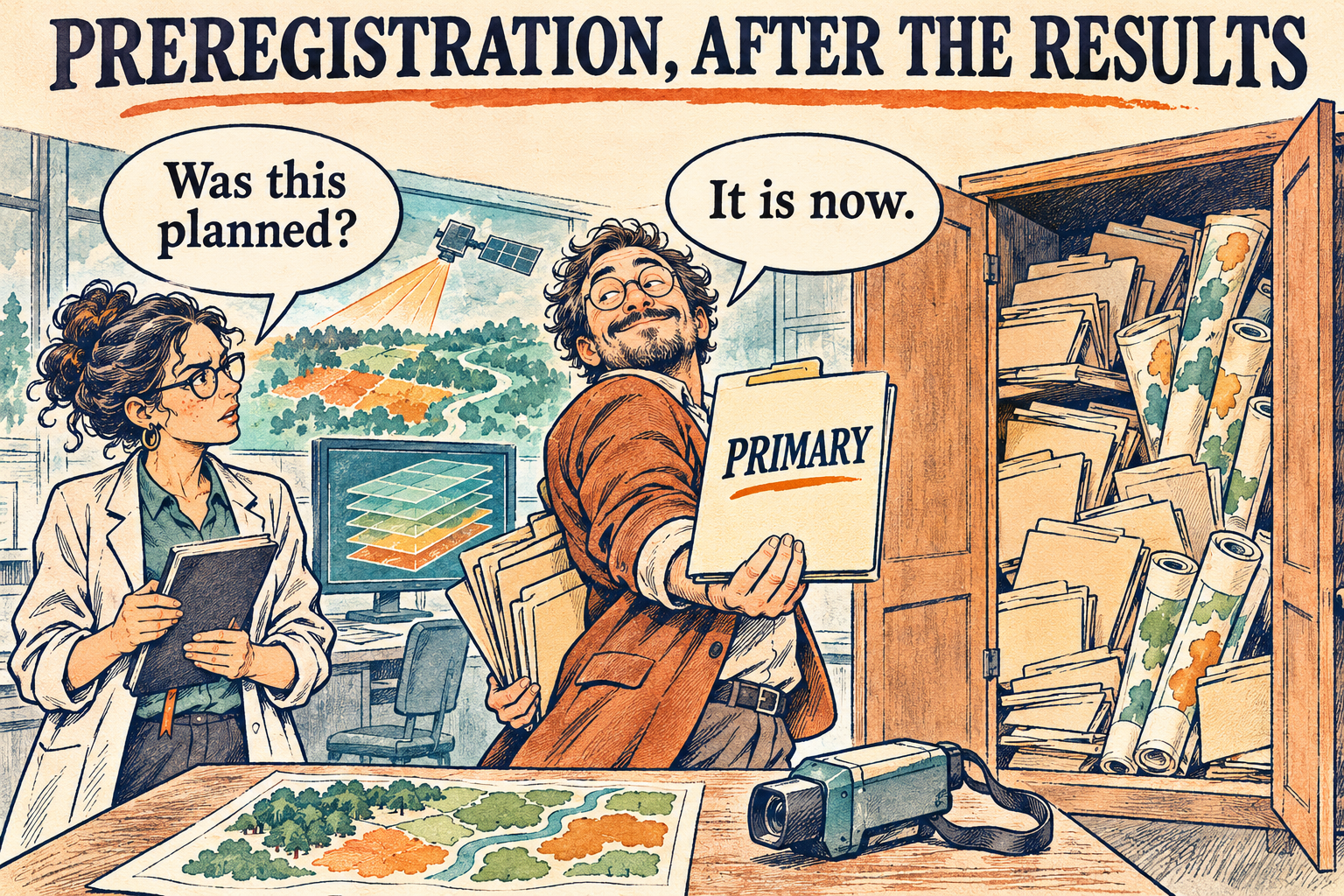
At our fictional remote-sensing lab, the primary analysis has just been born after a long afternoon of alternatives. It is immediately described as the original plan. Forty-seven neighbouring configurations are moved into a folder called miscellaneous. The surviving script reproduces perfectly. Its biography is less reproducible. Reviewer: “Why this analysis?” Author: “It was always the main one.” The version history coughs discreetly.
A final command can reproduce one selected path without revealing the outcomes that helped select it. Simmons, Nelson and Simonsohn demonstrate how undisclosed flexibility in data collection and analysis can inflate false-positive findings under their studied scenarios [1]. That does not make exploration improper. It makes the decision history relevant when a selected result is presented as though it emerged from one pre-specified test.
Preserve what was intended, attempted, abandoned and reported. A hypothesis generated during development can be valuable. It needs its actual evidential status, not a fictional childhood in a preregistration document. The lab is allowed to discover something surprising. It is not scientifically improved by announcing that the surprise had been expected all along, especially when the expectation first appears after the plot.
Sources: [1]
Please choose the question before meeting its favourite answer
The lab drafts a plan: use data, train models, report significance. This is an excellent description of several thousand incompatible analyses. A useful plan names the question, target population, primary comparison, outcome, evaluation unit and decision rule. It states which data support development, which remain for confirmation, and how failures, exclusions and deviations will be handled. Specificity is inconvenient mainly because it makes future changes visible.
In HSI research, the consequential choices can include spatial grouping, patch support, class inclusion, label budget, preprocessing fit scope, selection metric and classes absent from test scenes. Reviewer: “Was the mask fixed?” Author: “We fixed it when the cloudy pixels proved unhelpful.” A reasonable mask correction may still be justified. Its timing and rationale should not disappear from the report.
Exploratory projects do not need every line of code frozen before they begin. Define where flexibility ends and a confirmatory comparison starts. Record prior benchmark experience, inspected labels and earlier unsuccessful runs. Otherwise a plan written yesterday can sound as though it predates years of familiarity with the benchmark. The document should describe the information boundary, not merely possess a respectable date in its title.
The hash has no memory of yesterday
The author produces a configuration hash and announces preregistration. The reviewer congratulates the hash on identifying content, then asks when the content was chosen. A digest cannot answer that alone. A local timestamp can also be regenerated. Prospective registration requires an appropriate separately recorded, time-stamped process, with the exact protection depending on that process and the disclosures it contains. The string is not a witness just because it is difficult to pronounce.
Nosek and colleagues describe preregistration as clarifying the distinction between generating hypotheses from observations and testing hypotheses with new observations [2]. Existing benchmarks complicate that distinction because researchers may already know substantial details. Disclose that knowledge and identify the genuinely prospective decisions or held-out evaluations. The plan does not gain amnesia on the author's behalf.
Retrospective documentation can still improve transparency when labelled retrospective. Registration itself does not guarantee a sound design, valid labels or reproducible conclusions. Author: “But it is registered.” Reviewer: “Does the split answer the question?” A timestamp cannot repair spatial dependence, although it can establish exactly when the decision not to examine it was recorded.
Sources: [2]
Forty-eight configurations walk into an appendix
Consider a wholly illustrative design with two defensible cloud masks, three spatial-buffer settings, two candidate primary scores and four seeds. The full crossing contains 2×3×2×4 = 48 configurations. They are not necessarily 48 independent hypothesis tests, and the seeds are not four independently sampled scientific worlds. Our fictional author nevertheless selects one favourable configuration and introduces it as the obvious choice.
The table records what varies and why it matters. Cloud masks change evaluation support, buffers change separation and available data, score choices change selection objectives, and seeds describe stochastic variation. Some combinations may answer different questions and should not be pooled. Reviewer: “Where are the other configurations?” Author: “They were sensitivity analyses.” Reviewer: “Sensitive to being shown?” The point is to expose dependence on choices, not to display every spreadsheet as a separate discovery.
Use the count to describe the explored design, not as a mechanical multiplicity correction. Correlation, adaptation and differing estimands matter. Record which results informed later choices and whether a genuinely untouched evaluation remained. The number forty-eight is useful bookkeeping. It is not a universal divisor that can turn an undocumented search into a valid inferential procedure.
| Decision factor | Admissible values | Reason to document |
|---|---|---|
| Cloud mask | 2 | Changes evaluated support |
| Spatial buffer | 3 | Changes separation and available data |
| Primary-score candidate | 2 | Changes the selection objective |
| Training seed | 4 | Describes stochastic variation |
| Full crossing | 48 configurations | Records the explored design, not 48 independent studies |
A multiverse is not a wardrobe for inconvenient results
The team proposes reporting a multiverse. This initially means finding more settings under which the preferred method wins. Steegen and colleagues propose multiverse analysis to expose the consequences of reasonable data-construction choices [3]. The word reasonable is doing scientific work. A collection assembled by asking which branches have agreeable outcomes has not become transparent merely because the plot contains many lines.
Define admissible alternatives before inspecting their results where feasible. Include choices representing real uncertainty about the stated question, and explain exclusions. A mask that leaks information or an aggregation rule answering a different target need not join the analysis simply to make the universe larger. Not every possible setting deserves equal scientific standing, even if the configuration generator finds it extremely easy to enumerate.
Show which conclusions persist and which depend on particular factors. If one unusual definition supplies the win, say so. A bounded multiverse describes analytical sensitivity; it does not automatically justify a new significance claim or erase selection. Author: “The result survives across universes.” Reviewer: “Were the unfavourable universes admissible?” Cosmology is challenging enough without making the inclusion criteria depend on the abstract.
Sources: [3]
A second analyst discovers the unwritten specification
The fictional lab asks an independent analyst to reconstruct its metric and spatial split. The numbers differ. The original team suggests copying its code until the disagreement goes away. That would establish shared execution, but the written specification might still omit an ignore-mask rule or a decision about absent classes. The disagreement can reveal an assumption that never made it out of the first analyst's head.
Silberzahn and colleagues document variation among teams analysing the same dataset and question [4]. Their study shows that reasonable analytical decisions can differ without deliberate selective reporting. Here, an independent implementation can expose ambiguity in coordinates, aggregation and support. The cited teams are evidence for the methodological issue, not the characters in this fictional lab meeting.
Separate genuine implementation errors from choices that alter the estimand. Preserve the discrepancy and its resolution. Agreement after correction is useful evidence of a shared procedure, not proof that the procedure fits deployment or the labels are valid. Reviewer: “Why do the scripts now agree?” Author: “We agreed on what the metric means.” It is an unusually productive ending for a meeting that began by questioning whose laptop was statistically correct.
Sources: [4]
The deviation log is allowed to contain sensible decisions
A sensor fails, a class lacks support or an implementation defect invalidates a run. The lab can change its plan. The purpose of documentation is not to compel researchers to continue an obviously broken analysis with admirable administrative discipline. Record the reason, timing, affected analyses and information available when the change was made. Distinguish restoring the intended calculation from choosing a new target after seeing an inconvenient result.
Unexpected findings should be labelled exploratory and accompanied by the evidence that could test them independently. Retain primary results that do not favour the proposed method, even when a secondary condition produces an interesting improvement. Reviewer: “Was this subgroup predicted?” Author: “It was predicted immediately after we plotted it.” That is hypothesis generation, a useful activity with an unnecessarily confusing name if called confirmation.
Chambers introduced Registered Reports at Cortex, involving review of proposed methods before results [5]. The relevant principle reduces publication dependence on a favourable outcome. A local plan is not the same editorial arrangement, and neither guarantees good science. But both can make the original question harder to quietly replace when the data express a different aesthetic preference.
Sources: [5]
The final command and the decision history can coexist
The lab now keeps a compact record linking each claim to its planned comparison, data version, configuration, run identifiers, exclusions and result. Claims are marked confirmatory, exploratory or descriptive. Failed runs remain visible when they matter to reliability or resource requirements. Objective exclusion rules replace the earlier principle that a run becomes invalid when its score threatens the paragraph already written about it.
The final command recreates the reported calculation. The development record explains why that calculation was chosen. They do different work and can live together without making the repository unreadable. Transparency does not require treating every abandoned idea as a valid alternative, nor publishing every temporary file. It requires enough context to assess whether the conclusions depend on an undisclosed outcome-driven search.
Our fictional author finally describes which findings survive justified choices, which depend on assumptions and which need fresh evidence. The primary analysis keeps its title because its actual role is now clear. The wardrobe opens, the missing configurations return, and nobody is obliged to pretend that all forty-eight were independent experiments. Reviewer: “Was this planned?” Author: “This part was; this part was discovered.” The research has acquired a much more interesting story by giving up the invented one.
Frequently asked questions
Is exploration incompatible with rigorous research?
No. Exploration can generate valuable hypotheses. Distinguish it from confirmation, disclose how the hypothesis emerged and use appropriate independent evidence for a later confirmatory claim.
Does a configuration hash prove preregistration?
No. It identifies content but does not by itself establish when the content was chosen or which outcomes were already known. Use an appropriate time-stamped registration process when prospective registration is claimed.
Should every possible configuration be included in a multiverse?
No. Include justified alternatives that address genuine uncertainty about the stated question. Define their admissibility and report sensitivity without treating an arbitrary collection of settings as independent replications.
References and further reading
- Simmons, Nelson and Simonsohn (2011): False-Positive Psychology: Undisclosed Flexibility in Data Collection and Analysis Allows Presenting Anything as Significant. Psychological Science.
- Nosek et al. (2018): The preregistration revolution. PNAS, 115(11), 2600–2606.
- Steegen et al. (2016): Increasing Transparency Through a Multiverse Analysis. Perspectives on Psychological Science, 11(5), 702–712.
- Silberzahn et al. (2018): Many Analysts, One Data Set: Making Transparent How Variations in Analytic Choices Affect Results. Advances in Methods and Practices in Psychological Science.
- Chambers (2013): Registered reports: a new publishing initiative at Cortex. Cortex, 49(3), 609–610.
Reader feedback
Reads since 1 October 2026: at least 15 seconds with the article visible, counted once per browser per day. Reactions are anonymous and can be changed.
Loading reader feedback…
Discuss this article
Ask a technical question, challenge an assumption or share evidence from your own work.