
Define the decision and its cost
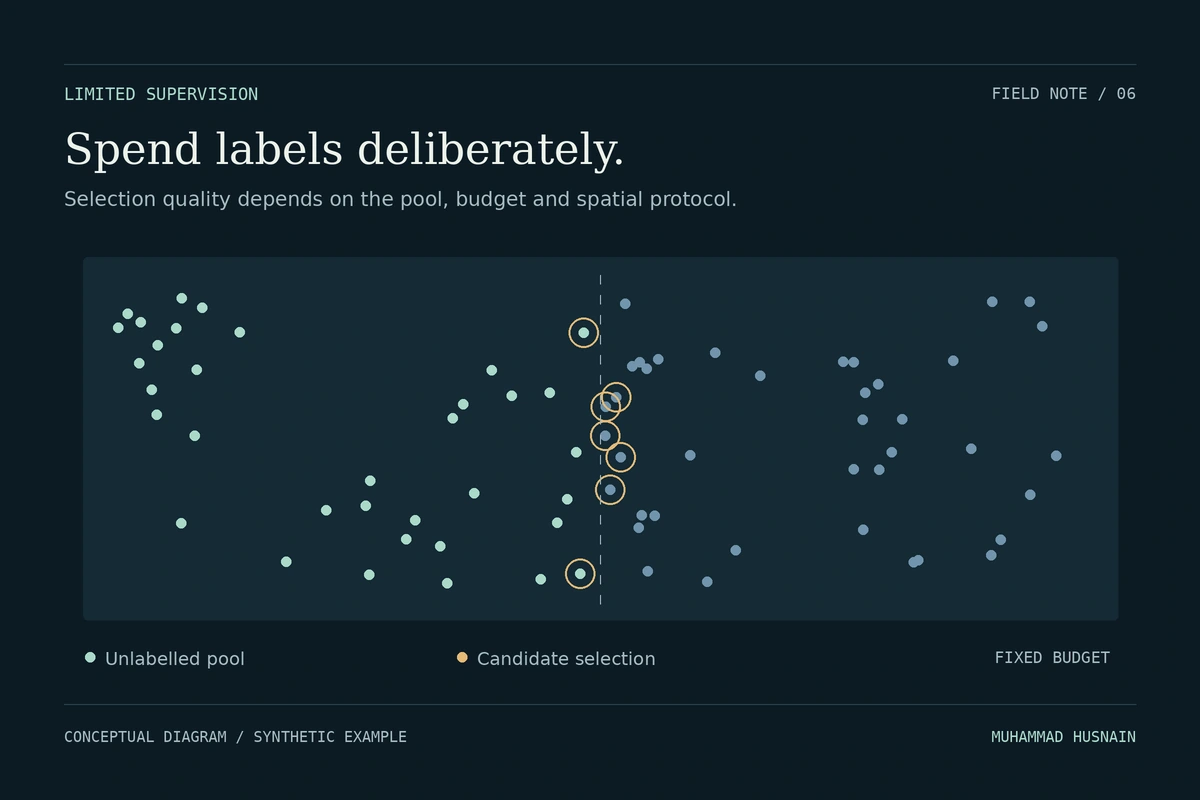
An active learner chooses which observations should receive labels next. In a hyperspectral map, the most uncertain hundred pixels may all lie along one boundary. Asking an expert to label those points can consume a substantial budget while adding little new information about other materials, objects or acquisition conditions.
This guide proposes a practical acquisition and evaluation protocol. It distinguishes the number of pixel labels from the effort required to obtain them. Its budgets and timings are illustrative. The objective is a model that improves at an acceptable annotation cost, with evidence that the acquisition policy contributes beyond random sampling.
Separate the pool, development set and final test
Partition geography before beginning the acquisition loop. The candidate pool contains examples the policy may query. A development set supports model and stopping decisions. The final test remains outside acquisition and tuning. Save these masks before the first round so that later choices cannot quietly expand the accessible region.
HSI spatial processing makes centre-only separation insufficient. Liang and colleagues show that overlap can bias spectral-spatial evaluation. [1] Extend the exclusion rule to each model’s patch footprint and to preprocessing operations that use neighbouring inputs. A selected point near the boundary of the candidate pool must not pull hidden test context into a training patch.
There is a useful transductive alternative in which the model may inspect the final scene without its labels. Declare that setting and use the same access for all acquisition policies. It answers a different question from transfer to a scene that was entirely unseen during learning.
Choose an annotation unit people can deliver
A point, a small polygon, a complete object and a field visit have different costs and label semantics. Record what the annotator sees and what is returned. If one polygon is assigned a class and rasterised into 2,000 pixels, report the polygon and the resulting pixels; do not describe the result as 2,000 independent human judgements.
For a controlled initial benchmark, point queries with a fixed viewing interface are easy to count. For an operational study, time each query and include navigation, uncertainty resolution and quality review. A low-cost question may be more valuable per minute than a high-entropy pixel whose material cannot be identified from available evidence.
Permit an explicit unresolved response. A person should not have to invent a class for a mixed pixel, occlusion or unfamiliar material. Record why the query could not be answered and its time cost. Excluding these cases from the budget would make difficult acquisition policies look artificially efficient.
Compare uncertainty with diversity
Uncertainty ranking is a useful baseline: choose predictions with low confidence or high entropy, using one fixed score. It does not by itself ensure a diverse batch. Nearby spectra may be almost identical, and systematic model errors may be confidently wrong.
The core-set approach of Sener and Savarese motivates acquisition through the geometry of learned representations. BADGE combines uncertainty and diversity through gradient embeddings. BatchBALD selects batches using joint information about model parameters. These are three different primary-source approaches to avoiding redundant acquisition; none automatically establishes effectiveness for a particular HSI scene. [2] [3] [4]
An HSI comparison can include uniform random sampling, uncertainty alone and one diversity-aware policy. Add a spatially spread random baseline when geography is central to the proposed method. Otherwise an apparent gain may come from distributing queries across the scene rather than from the sophisticated acquisition score.
Make the round budget explicit
Consider an illustrative four-class task starting with ten labels per class. The initial set contains 40 labels. Eight rounds acquiring 20 new labels each end at 200 labels, before any separate development or quality-control labels. Save the initial set and every acquisition batch for every policy.
If the first 20 queries take 15 seconds each, their nominal annotation time is five minutes. If another batch contains difficult boundaries requiring 45 seconds per query, it takes fifteen minutes for the same label count. These are constructed times, not measured productivity. They demonstrate why a curve against labels alone cannot establish a time saving.
Compare policies at equal cumulative labels and, when timing is available, at equal cumulative annotation time. Include rejected or unresolved questions and corrections. Report model scoring and retraining time separately: an acquisition method that saves five minutes of annotation but adds hours of computation may still be useful, but its trade-off should be visible.
Protect the initial-set comparison
Use the same initial labels for all policies within a replicate. Repeat the entire experiment with several independently selected initial sets, because a lucky first set can dominate a small-budget learning curve. Keep the classifier, optimisation schedule, augmentation and accessible unlabelled data matched.
Decide in advance whether each round retrains from scratch or continues from the previous checkpoint. Both can be legitimate, but they induce different optimisation histories. If a proposed policy uses a stronger pretrained encoder than its comparator, include a baseline using that encoder before claiming an acquisition benefit.
When initial labels are class-balanced using complete reference labels, disclose that oracle assistance. In an actual unlabelled deployment, the class of a candidate is unknown until acquisition. A reproducible study can evaluate an oracle-balanced initialisation as a controlled condition while separately describing how an operational initial set would be obtained.
Track rare-class discovery and repeated queries
A policy may improve overall accuracy by repeatedly labelling common classes. Track the acquired class distribution after annotation, the number of distinct objects or regions reached, and the first round in which each rare class is discovered. Do not use undisclosed ground-truth class balancing inside the acquisition policy.
For a newly encountered class, define the action before running the experiment: add a new output class, route it to a separate discovery process, or record it as outside the current task. These choices change the learning problem. An unresolved material should not silently become background.
Keep duplicate checks at both pixel and object levels. Querying a neighbouring pixel can be useful for a boundary question, but repeated requests on one already understood object need an explicit purpose. Report spatial coverage alongside any feature-space diversity score; neither is a substitute for the other.
Evaluate the whole learning curve
Plot performance at the initial budget and after each round, using the same evaluation set throughout. Select the primary summary before examining results: performance at a fixed budget, labels required to reach a predefined target, or area under the learning curve over a stated budget interval. Different summaries can rank policies differently.
Use paired policy differences within the same initial-set replicate. Show per-class or object-level outcomes relevant to fine detail, as well as overall scores. A policy that reaches common classes quickly but never acquires the small target is not successful for a target-recovery task.
The reporting table below separates acquisition evidence from classifier evidence. It is a proposed audit format rather than a claim that any particular policy wins.
| Stage | Record |
|---|---|
| Before round 0 | Geographic masks, initial labels, ontology and budget |
| Before acquisition | Checkpoint, score definition, candidate eligibility and seed |
| After annotation | Returned labels, unresolved cases, time and quality corrections |
| After training | Training configuration, stopping rule and checkpoint |
| Evaluation | Fixed-budget scores, rare-class discovery and paired variation |
| Release | Ordered query manifest and cumulative cost ledger |
Define a stopping rule before the last round
Choose a maximum cost or a development-based stopping rule before final testing. If the final test curve determines when acquisition stops, the test has influenced the workflow. A fixed budget is often the simplest interpretable first experiment.
After the loop, inspect where the policy spent its effort. Did it discover new material variation, clarify disputed boundaries, or revisit the same region? These records explain why the curve changed and help decide the next annotation campaign. Continue with experiment tracking to keep the acquisition history connected to its models and results.
Frequently asked questions
Should active learning always select the most uncertain pixels?
No. Uncertainty alone may select redundant or unanswerable observations. Compare it with random sampling and a diversity-aware policy under the same budget.
Can full ground truth simulate an annotator?
It can support a controlled benchmark if the acquisition policy cannot inspect hidden labels. Such a simulation does not measure human annotation time, disagreement or field verification cost.
What counts towards the annotation budget?
Define it before acquisition. At minimum count the initial labels and all acquired labels; separately account for development labels, unresolved queries, corrections and annotation time.
References and further reading
- Liang et al.: On the Sampling Strategy for Evaluation of Spectral-Spatial Methods in Hyperspectral Image Classification
- Sener and Savarese: Active Learning for Convolutional Neural Networks: A Core-Set Approach
- Ash et al.: Deep Batch Active Learning by Diverse, Uncertain Gradient Lower Bounds
- Kirsch, van Amersfoort and Gal: BatchBALD: Efficient and Diverse Batch Acquisition for Deep Bayesian Active Learning
Reader feedback
Reads since 1 October 2026: at least 15 seconds with the article visible, counted once per browser per day. Reactions are anonymous and can be changed.
Loading reader feedback…
Discuss this article
Ask a technical question, challenge an assumption or share evidence from your own work.