
Statistically Significant Nonsense · Episode 14
The lab, characters, dialogue and situations are fictional. The satire targets methodological habits and overclaiming, not named researchers or cited authors. Numerical examples are explicitly labelled illustrations, not measured benchmark results.
A vacancy for one representative run
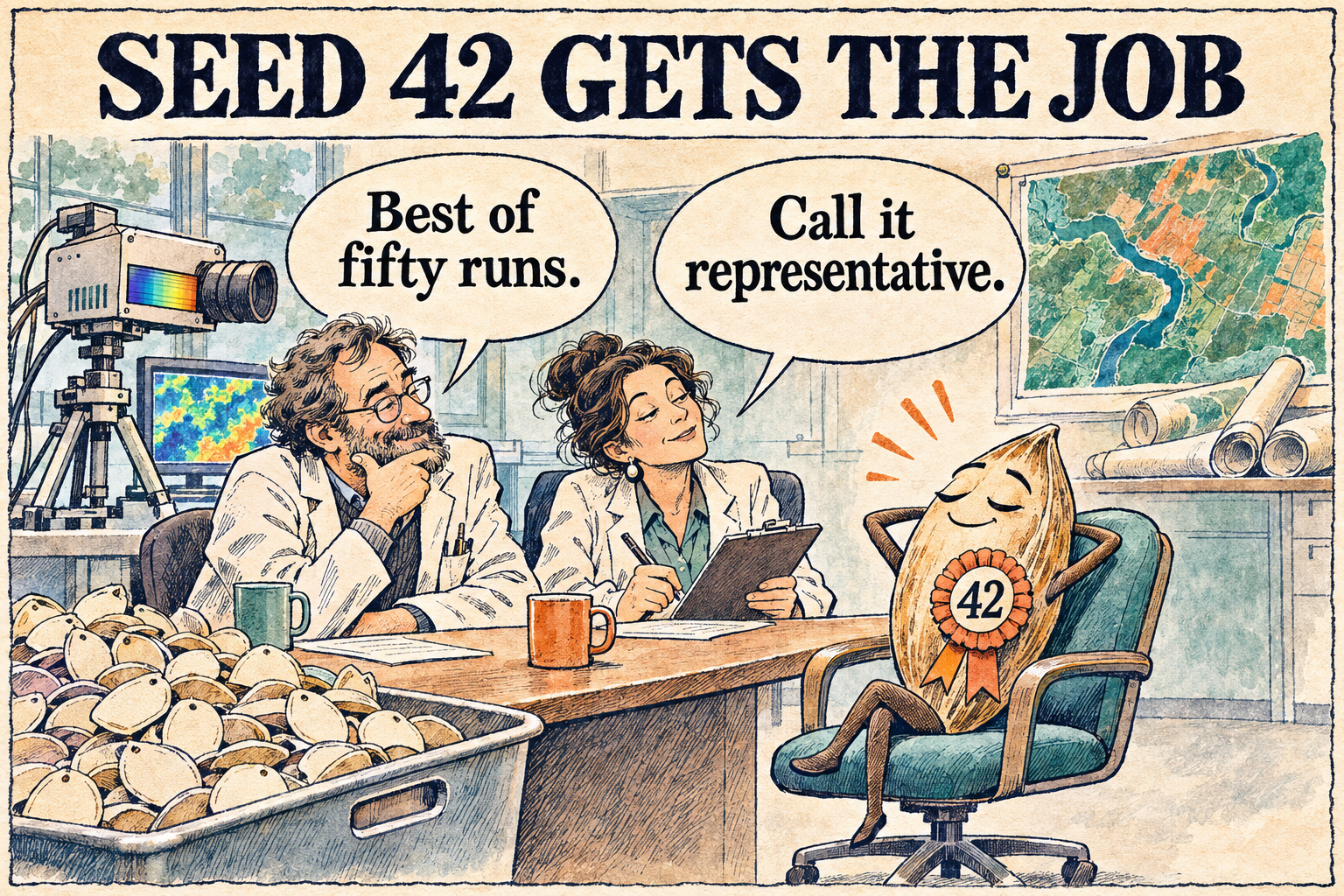
The fictional Institute for Fortunate Initialisation has interviewed fifty seeds and appointed the highest-scoring one as its representative experiment. Seed 42 brings excellent leadership qualities, including a favourable minibatch order and the ability to appear alone in the main table. The other forty-nine candidates have been thanked for their interest.
“Why this run?” asks the reviewer. “It is representative,” replies the lab, using representative in its specialist meaning of currently employed. The test score is beautiful. The recruitment process is missing.
A seed controls stochastic inputs to a particular computation. It does not certify an experiment as typical or independent. Bouthillier and colleagues examine several sources of benchmark variability, including sampling, augmentation, initialisation and hyperparameter choices. [1] Before reporting a mean or a winning candidate, define which process varied. Otherwise the paper's error bars may describe an entirely different job from the one advertised in its conclusion.
Sources: [1]
The candidate has several undisclosed side appointments
Our seed controls the split, support-set selection, initial weights, minibatch order, augmentation and dropout. We add one random augmentation call and later random draws change. Seed 42 insists this is a different career opportunity, despite the identical name badge.
List operations that consume randomness. Where feasible, use documented generators or derived streams for distinct tasks. Save realised split and support manifests, not merely the integer that generated them. Library versions, dataset ordering and implementation changes can affect what the same seed reconstructs. A list of integers is useful provenance, but the actual observation identities are stronger evidence of what was selected.
Two architectures can consume different numbers of random draws during initialisation. Subsequent values may therefore differ even when both begin with 42. If paired comparisons are intended, preserve the shared evaluation conditions directly. Giving two researchers the same shopping budget does not establish that they returned with the same groceries, particularly when one bought an additional attention head.
Reproducible employment is not robust employment
The lab reruns its favourite seed and obtains the same result. This is excellent evidence that the run can be repeated under the checked conditions. It is not evidence that the remaining seeds have withdrawn their objections. Determinism reproduces a computation; robustness asks what happens when relevant conditions vary.
PyTorch cautions that identical seeds do not guarantee matching results across releases, platforms or CPU and GPU execution. It distinguishes controlling random generators from selecting deterministic operations, which can affect performance. [2] Record the framework, device, precision and settings. Verify repeatability where claimed, and describe remaining nondeterminism instead of attributing every discrepancy to scientific discovery.
Our fictional institute now has two personnel files: one for reproducing the appointed run and another for assessing the hiring process. This is administratively inconvenient but scientifically helpful. An exactly repeatable lucky result remains lucky. The software has simply become very reliable at returning to it.
Sources: [2]
Five paired candidates, with the arithmetic visible
The table contains five invented matched conditions, not observed HSI results. Method A minus Method B gives differences of 1, 2, 1, 1 and 1 percentage points. Their mean is 1.2 points. The sample standard deviation, using denominator four, is approximately 0.447 points. Dividing by the square root of five gives a standard error of 0.2 points, provided the paired differences are independent draws from the target process.
The standard deviation describes variation among effects. The standard error concerns precision of their mean under those assumptions. Neither acquires a new interpretation because a smaller error bar fits more neatly beside the bold score.
Pairing must reflect shared conditions, such as the same admissible split and support selection. Matching unrelated runs by row number is merely spreadsheet choreography. The five synthetic pairs establish the arithmetic, not an adequate sample size, a valid significance claim or a general conclusion about hyperspectral methods.
| Condition | Method A | Method B | A minus B |
|---|---|---|---|
| 1 | 80 | 79 | 1 |
| 2 | 82 | 80 | 2 |
| 3 | 81 | 80 | 1 |
| 4 | 83 | 82 | 1 |
| 5 | 79 | 78 | 1 |
Five employees, one assigned campus
The institute assigns five newly hired models to the same scene and announces five independent geographical deployments. All five employees report to one campus. Its acquisition conditions, annotation errors and land-cover structure did not multiply when the optimiser restarted.
Training repeats can characterise variability conditional on a fixed scene and split. New acquisitions address a different source of uncertainty. A useful design may nest training runs within independently obtained scenes or declared sampling units, preserving that hierarchy in analysis. Repeated cross-validation folds also share observations; counting every score as independent can understate uncertainty.
For HSI maps, adjacent pixels and overlapping receptive fields add further dependence. The spatial uncertainty guide discusses suitable resampling units. No seed schedule repairs leakage or creates missing environmental coverage. Seed 42 may be an outstanding employee, but its contract does not authorise it to manufacture a new sensor, season or city by changing the random-number generator.
The other candidates request a distribution
The rejected runs ask whether readers could see their scores. The institute worries this might distract from the representative result. Precisely. A distribution provides the information that choosing one photogenic run removes.
Reimers and Gurevych demonstrate the importance of score distributions in their study of LSTM sequence tagging. [3] Their empirical results concern those NLP systems, not HSI models. The practical response is to inspect and report the variability observed in your own procedure: individual runs, a useful distribution summary and clearly labelled uncertainty.
Choose statistical tests for the actual metric, pairing and independent unit. Dror and colleagues discuss those dependencies for NLP significance testing. [4] Do not import a familiar test as a decorative seal. Report interpretable effects and practical thresholds, identify standard deviations versus confidence intervals, and account for exploratory selection across metrics or models. A p-value cannot retrospectively turn a talent contest into a random sample.
Selecting a seed is allowed to have a name
Sometimes deployment genuinely permits training several candidates and selecting one on validation data. That is a model-selection procedure, and it can be useful. Record the number of attempts, selection rule and cost, then evaluate the selected procedure appropriately. The objection is to concealing the auditions or using final test scores to choose the winner.
Predeclare evaluation seeds where feasible. Preserve low-scoring and failed runs, with a consistent policy distinguishing infrastructure interruptions from algorithmic divergence. Restarting a job after a machine outage is different from repeatedly restarting an unstable method until it looks dependable. Both events belong in the record when they affect interpretation.
Henderson and colleagues examine reproducibility difficulties in deep reinforcement learning, including variability and reporting practices. [5] Their findings do not prescribe a universal seed count for HSI. They do suggest that our fictional recruitment office should stop deleting every applicant who failed the final test and then announcing an exceptional retention rate.
Sources: [5]
How many seeds does the committee want?
The reviewer asks for more seeds. The institute proposes three because three fits the remaining compute allocation and has a pleasing academic familiarity. There is no universal number that makes a stochastic experiment sufficiently precise. A conventional run count is not a calibration certificate.
Use a pilot to assess variability relative to the smallest effect that would change the conclusion. Decide whether the next resource should fund another initialisation, support selection, scene or acquisition. The answer follows the target of inference. More initialisations can be valuable, but not when the central uncertainty is how the model behaves on a different sensor.
Specify a stopping rule before repeatedly inspecting the final comparison. Fixed repetition counts are straightforward; sequential designs need appropriate analysis. Continuing until a threshold is crossed makes the stopping decision part of the procedure. Seed 42 cannot be allowed to keep interviewing replacements until the committee finally hears the answer it wanted.
The appointment letter now includes an appendix
Release configurations, dataset and split identifiers, random-stream settings, environment details, checkpoint-selection rules and run outputs. Include the script that turns those records into the published summary. If exact resumption matters, save relevant generator, optimiser and scheduler states; restarting from the original integer does not generally recreate the state halfway through training.
The experiment-tracking guide connects these records to usable artefacts. Keep three claims distinct: a run is repeatable in the tested environment, a method is stable across the declared stochastic inputs, and performance generalises to independently obtained data. Evidence for one does not automatically establish the others.
Our fictional institute can retain its excellent candidate. It simply reports the selection procedure and the wider distribution. Seed 42 is no longer asked to speak for forty-nine missing colleagues, six unobserved cities and the entire future of remote sensing. Its revised job description is shorter. The paper is considerably more informative.
Frequently asked questions
Does using the same seed make two methods paired?
Not by itself. Pairing requires shared, relevant experimental conditions. Different programs can consume random numbers differently even when their seed integers match.
Are more seeds a substitute for more scenes?
No. They can characterise training variation conditional on the observed scenes. They do not create independent acquisitions or establish transfer to unseen environments.
Should I report standard deviation or standard error?
Report the quantity that answers the question and label it explicitly. Standard deviation describes variation among runs; standard error estimates precision of a mean under stated assumptions.
References and further reading
- Bouthillier et al. (2021). Accounting for Variance in Machine Learning Benchmarks.
- PyTorch. Reproducibility, version 2.15 documentation.
- Reimers and Gurevych (2017). Reporting Score Distributions Makes a Difference: Performance Study of LSTM-networks for Sequence Tagging.
- Dror et al. (2018). The Hitchhiker’s Guide to Testing Statistical Significance in Natural Language Processing.
- Henderson et al. (2018). Deep Reinforcement Learning that Matters.
Reader feedback
Reads since 1 October 2026: at least 15 seconds with the article visible, counted once per browser per day. Reactions are anonymous and can be changed.
Loading reader feedback…
Discuss this article
Ask a technical question, challenge an assumption or share evidence from your own work.